Secure Software Development Lifecycle
Click any control badge to view its details. Download SVG
Key Control Areas
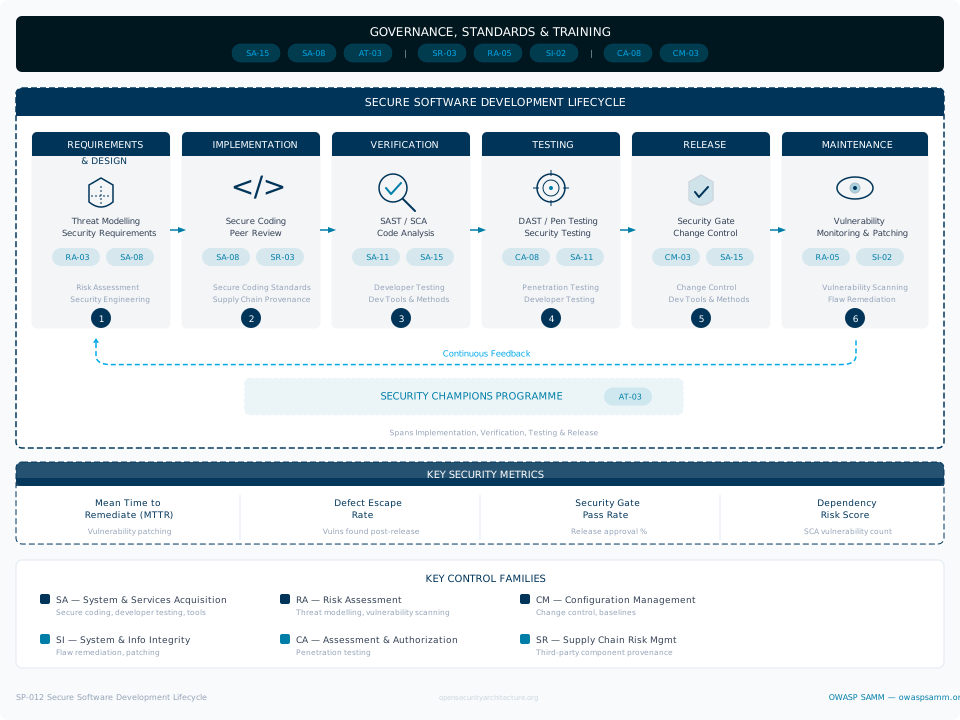
Threat Modelling and Secure Design
Secure Coding Standards and Developer Training
Static Analysis and Code Review
Software Composition Analysis and Supply Chain
Dynamic Analysis and Security Testing
Security Gates and Release Management
Vulnerability Management and Maintenance
When to Use
This pattern applies to every organisation that develops or commissions software. It is particularly critical for: organisations developing internet-facing applications, SaaS providers processing customer data, financial services firms subject to DORA's ICT risk management requirements, organisations subject to PCI DSS requirement 6 (develop and maintain secure systems), healthcare organisations developing systems that process patient data, organisations with regulatory obligations around software security (FCA, SEC, PRA), any organisation that has experienced a security incident caused by a software vulnerability, and organisations adopting DevOps or CI/CD who want to embed security from the start rather than retrofit it.
When NOT to Use
Organisations that exclusively use SaaS products and do no custom development do not need a full SSDL -- but they should still assess the SSDL practices of their SaaS vendors (see SA-04). Very small development teams (1-3 developers) should prioritise automated tooling (SAST, SCA, secrets scanning) over process-heavy approaches like formal threat modelling -- a lightweight security checklist at design time may suffice. Organisations should not attempt to implement all SSDL practices simultaneously: start with the highest-value automated checks (SCA for known CVEs, secrets scanning, basic SAST) and mature incrementally.
Typical Challenges
The greatest challenge is developer adoption: security tools that generate excessive false positives are quickly ignored, and security gates that block delivery without clear justification are circumvented. Tool tuning is essential -- invest time in configuring SAST rules, suppressing known false positives, and establishing severity thresholds that developers trust. Security champions are hard to recruit and retain: the role requires security interest plus development credibility, and champions often burn out if they become the sole security contact for their team. Threat modelling adoption is inconsistent: teams understand the value but struggle to find time during sprint planning, leading to threat models that are either skipped or produced as compliance artefacts rather than genuine design exercises. Legacy applications present the biggest gap: applying modern SSDL to new development is relatively straightforward, but retrofitting security into legacy codebases generates overwhelming finding volumes that paralyse remediation. Dependency management is a constant battle: modern applications have hundreds of transitive dependencies, vulnerability alerts arrive daily, and patching one dependency often breaks another. Measuring SSDL effectiveness is difficult: fewer production vulnerabilities could mean the process is working or that nobody is looking hard enough.
Threat Resistance
Secure SDLC prevents vulnerabilities from reaching production. Injection attacks (SQL, command, LDAP, XSS) are caught by SAST rules that detect unsanitised input flowing to dangerous sinks, and by DAST scans that probe for injection points in running applications (SA-11, SI-10). Known vulnerable dependencies are detected by SCA before deployment and monitored continuously post-deployment, preventing exploitation of published CVEs (SR-03, RA-05). Insecure authentication and session management flaws are identified through threat modelling (design phase), secure coding standards (implementation phase), and security testing (verification phase), providing multiple layers of defence (SA-08, SA-11). Supply chain attacks through compromised dependencies are mitigated by dependency pinning, integrity verification, and SCA monitoring that detects unexpected changes in package behaviour (SR-03, SR-04). Hardcoded credentials and secrets in source code are caught by pre-commit hooks and CI scanning before they reach the repository, preventing credential exposure through repository leaks (SA-11, IA-05). Business logic vulnerabilities -- the category that automated tools miss -- are addressed through threat modelling that identifies abuse cases and penetration testing that targets complex attack chains (SA-11, CA-08).
Assumptions
The organisation develops software (in-house or through contracted development). A CI/CD pipeline exists or is being established (see SP-028). Development teams use version control (Git). Some security awareness exists within the development organisation. Management supports the investment in security tooling and the acceptance of security gates that may slow delivery. Budget exists for SAST/DAST/SCA tooling (commercial or open-source).
Developing Areas
- AI-assisted code generation is creating new vulnerability patterns that traditional SAST tools were not designed to detect. Large language models (GitHub Copilot, Amazon CodeWhisperer, Cursor) generate plausible but subtly insecure code -- using deprecated cryptographic functions, introducing race conditions, or producing input validation that handles common cases but fails on adversarial input. Studies show that AI-generated code contains vulnerabilities at rates comparable to or higher than human-written code, and developers using AI assistants tend to review generated code less critically. Security tooling specifically designed to audit AI-generated code is emerging but immature.
- Software Bill of Materials (SBOM) adoption is advancing through regulatory pressure (US Executive Order 14028, EU Cyber Resilience Act) but consumption maturity lags far behind generation maturity. Organisations can produce SBOMs in SPDX or CycloneDX format, but the tooling to ingest SBOMs from suppliers, correlate them with vulnerability databases, and integrate findings into existing vulnerability management workflows is fragmented. The challenge is not producing SBOMs but building operational processes around them -- particularly for organisations consuming hundreds of SBOMs from their software supply chain.
- Software attestation frameworks, particularly SLSA (Supply-chain Levels for Software Artifacts), define graduated levels of supply chain integrity assurance from basic provenance tracking (Level 1) to hermetic, reproducible builds (Level 3). While SLSA provides a clear maturity model, achieving Level 2 or above requires significant build infrastructure investment including isolated build environments, signed provenance metadata, and tamper-proof build logs. Fewer than 10% of organisations have implemented SLSA beyond Level 1, and the tooling ecosystem (Sigstore, in-toto, Witness) is still consolidating.
- Shift-left fatigue is becoming a measurable problem in organisations that have aggressively embedded security checks into developer workflows. When SAST, SCA, secrets scanning, licence compliance, container scanning, and infrastructure-as-code scanning all run on every pull request, build times increase, alert volumes overwhelm, and developers begin ignoring or bypassing security findings. The emerging response is intelligent orchestration platforms (Apiiro, Ox Security) that risk-rank findings and route only material alerts to developers, but calibrating these systems to avoid both alert fatigue and genuine-miss risk is an ongoing challenge.
- Security champion programme effectiveness is difficult to measure and programmes frequently stall after initial enthusiasm. Research suggests that effective programmes require at least 10% dedicated time allocation, executive sponsorship, career path incentives, and a community structure that prevents champions from becoming isolated. Organisations that treat the champion role as a volunteer add-on to an already full development workload report attrition rates above 40% annually, undermining the distributed security model they are trying to build.
Related Patterns
Patterns that operate within or alongside this one. Click any to view.