Awareness and Training Pattern
Click any control badge to view its details. Download SVG
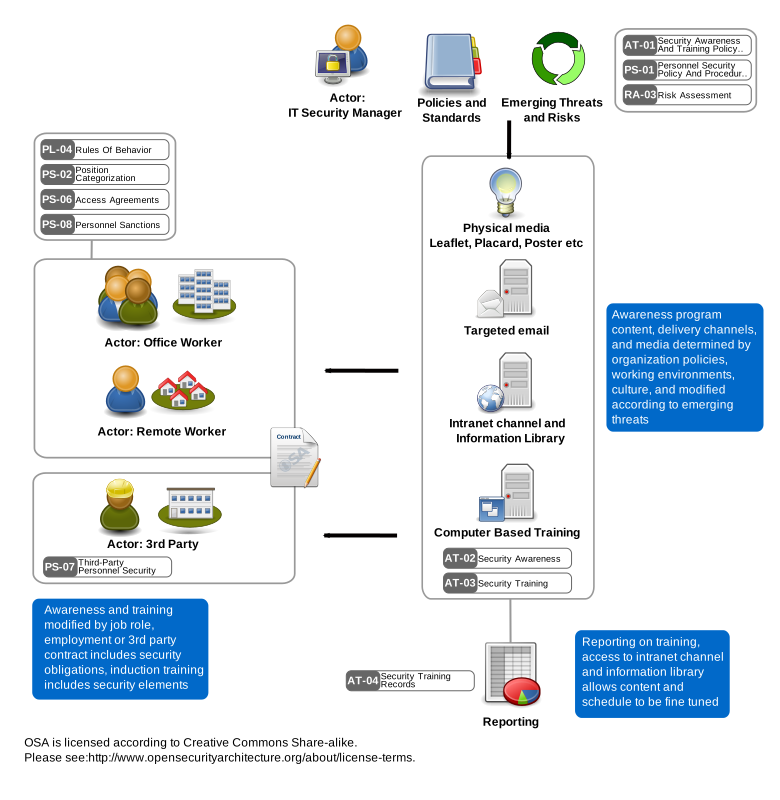
Key Control Areas
Security Awareness Program
Role-Based Security Training
Personnel Security Lifecycle
Third-Party Personnel Security
Incident Response and Reporting Culture
Contingency and Business Continuity Awareness
Risk-Informed Program Design
When to Use
All organisations that employ people or engage third parties with system access should implement this pattern. It is universally applicable and is a mandatory requirement under virtually every compliance framework (ISO 27001 A.6.3, NIST CSF GV.AT, PCI DSS 12.6, SOC 2 CC1.4, CIS Control 14). Specific triggers for enhanced investment: high phishing click rates in simulation; repeat security incidents caused by human error; regulatory findings citing training deficiencies; significant organisational growth or transformation; adoption of new technologies (cloud, AI, remote work) that change the risk profile; or industry-specific regulations mandating awareness programs (financial services, healthcare, critical infrastructure).
When NOT to Use
There are no legitimate contra-indications for this pattern. Any organisation with personnel and information systems requires security awareness. The scope and depth should be proportionate to the organisation's risk profile, but a zero-investment approach is never appropriate. Even very small organisations benefit from basic security hygiene awareness.
Typical Challenges
Engagement fatigue is the primary challenge: staff who view security awareness as a bureaucratic checkbox will not change behaviour regardless of content quality. Combat this through variety in delivery, relevance to role, real-world examples, and executive visible participation. Measuring genuine effectiveness versus completion rates requires investment in simulation tools and analytics. Budget constraints often reduce awareness programs to the minimum required for compliance, which is insufficient for actual risk reduction. Reaching third-party personnel who may not use the organisation's systems for training delivery. Keeping content current as threats evolve -- phishing techniques, social engineering tactics, and technology risks change faster than annual training cycles. Multilingual and multi-cultural workforces require localised content. Remote and hybrid workforces are harder to reach with physical security messaging and more susceptible to certain attack vectors. Shadow IT and personal device usage create awareness gaps that organisational training cannot fully address. Balancing security messaging with productivity -- excessive warnings create alert fatigue and are counterproductive.
Threat Resistance
Social engineering and phishing -- the most common initial attack vector in breach data year after year, with trained staff providing the primary defence layer. Business email compromise targeting finance and executive personnel. Insider threats, both malicious and negligent -- awareness of monitoring, policy, and consequences deters deliberate misuse while training reduces accidental incidents. Credential compromise through weak passwords, password reuse, and credential sharing -- awareness drives adoption of password managers and MFA. Data handling errors including misclassification, misdirected communications, and improper disposal. Physical security breaches including tailgating, unsecured workstations, and improper document disposal. Shadow IT and unauthorised service usage where employees bypass approved channels. Regulatory non-compliance where training requirements are unmet. Supply chain and third-party personnel exploitation. Delayed incident reporting that increases attacker dwell time and breach impact.
Assumptions
The organisation has a defined information security policy framework that awareness and training can reference. Management commitment exists to fund and support the program -- awareness without executive sponsorship is performative. Personnel have allocated time for training activities during working hours. The organisation has mechanisms to track training completion and measure effectiveness. For third-party coverage, contractual authority exists to mandate training compliance. Content delivery infrastructure (LMS, email, intranet) is available. The threat landscape is dynamic and the program must adapt -- training content from two years ago is already partially obsolete.
Developing Areas
- AI-generated phishing is rendering traditional awareness training increasingly inadequate. Large language models produce grammatically flawless, contextually personalised phishing emails that lack the spelling errors and awkward phrasing that users were trained to detect. AI-generated voice clones (vishing) and real-time video deepfakes in video calls are emerging attack vectors that existing training programmes do not address. The training industry is scrambling to develop exercises that teach users to verify requests through out-of-band channels rather than relying on content-based detection of social engineering attempts.
- Measuring security culture as distinct from training compliance is an evolving discipline with no consensus methodology. Traditional metrics (completion rates, phishing simulation click rates) measure behaviour in test conditions, not genuine cultural embedding. Emerging approaches use sentiment analysis of internal communications, voluntary security reporting rates, time-to-report for genuine incidents, and anonymous culture surveys with psychometric frameworks adapted from safety culture research. However, correlating these culture metrics with actual security outcomes (breach rates, incident severity) requires longitudinal data that most organisations have not yet accumulated.
- Personalised adaptive training platforms that adjust content difficulty, topic selection, and delivery frequency based on individual user behaviour are emerging but adoption is limited. These platforms use machine learning to identify which users are most susceptible to specific attack types and deliver targeted micro-training at the moment of highest receptivity. Early evidence suggests 30-40% better retention compared to one-size-fits-all annual training, but the data requirements for personalisation raise privacy concerns that European organisations in particular must navigate carefully under GDPR worker monitoring provisions.
- Deepfake awareness for voice and video communications is becoming an urgent training need as the technology required to clone voices from short audio samples becomes freely available. Reported incidents of AI-generated voice calls impersonating executives to authorise wire transfers have increased dramatically, with individual losses exceeding $25 million in documented cases. Training programmes must now cover verification procedures for verbal instructions, particularly for financial transactions and privileged access requests, but the training content and simulation tools for deepfake awareness are still in early development.
Related Patterns
Patterns that operate within or alongside this one. Click any to view.