Incident Response
Click any control badge to view its details. Download SVG
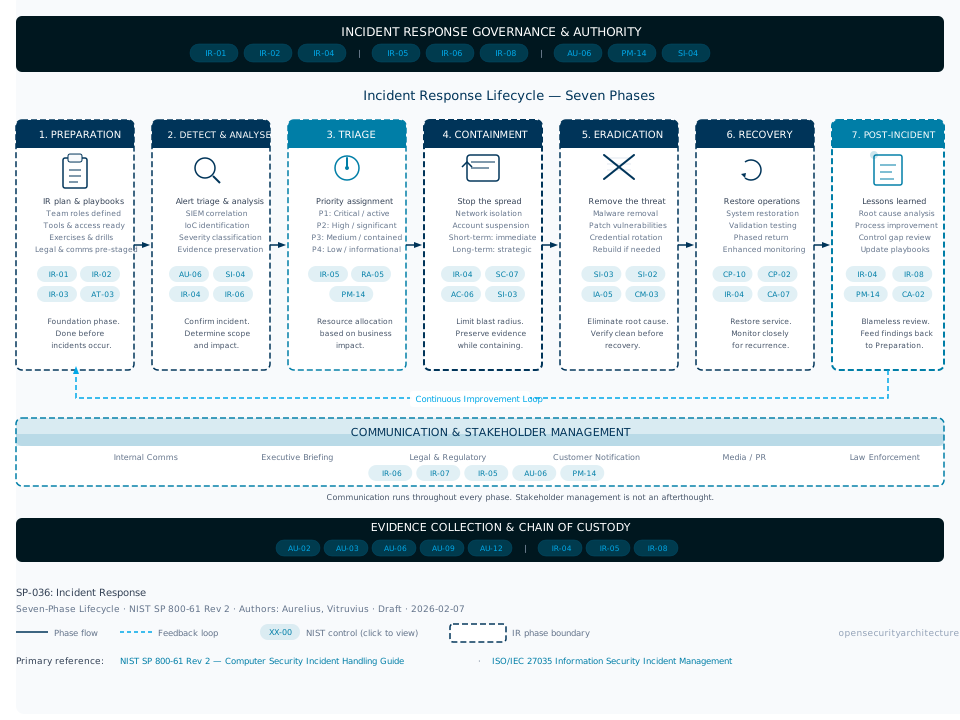
Key Control Areas
Incident Response Programme and Preparation
Detection, Classification, and Triage
Containment Strategies
Evidence Handling and Forensic Investigation
Communication and Stakeholder Management
Eradication and Recovery
Post-Incident Review and Continuous Improvement
Incident Response Team Structure and Readiness
When to Use
This pattern applies to every organisation that operates information systems -- incident response capability is not optional. It is particularly critical for: regulated financial services firms with notification obligations to FCA, PRA, BoE, or equivalent regulators, organisations subject to GDPR or equivalent data protection regulations, critical national infrastructure operators with NCSC reporting obligations, organisations that process payment card data (PCI DSS requirement 12.10), healthcare organisations subject to breach notification requirements, any organisation that has experienced an incident and recognised the need for structured response capability, and organisations with cyber insurance that requires demonstrated incident response capability.
When NOT to Use
There are no contraindications for incident response capability -- every organisation needs it. The scale and formality of the capability varies: a five-person startup needs a documented plan and tested communication procedure, not a 24/7 SOC. Very small organisations should consider managed detection and response (MDR) services that include incident response capability rather than building in-house. Organisations that outsource all IT to managed service providers still need their own incident response plan -- the MSP handles technical response, but the organisation retains responsibility for business decisions, regulatory notification, and stakeholder communication.
Typical Challenges
The most common failure is lack of preparation: organisations that have not tested their incident response plan discover its gaps during a real incident, when the cost of discovery is highest. Incident classification is subjective and politically charged: nobody wants to declare a Critical incident with its mandatory notifications and executive involvement. Containment decisions involve difficult trade-offs: isolating a compromised production system stops the adversary but also stops the business. Evidence preservation conflicts with rapid containment: the fastest way to stop an attack (reimaging the system) destroys the forensic evidence needed to understand it. Communication breaks down under pressure: stakeholders receive conflicting information, regulatory notifications are delayed because nobody is sure of the trigger criteria, and media enquiries are handled ad hoc. Skilled incident responders are scarce and expensive: retainer agreements provide surge capability but response time SLAs may not meet the urgency of a fast-moving incident. Post-incident reviews are deprioritised as teams return to normal operations, losing the learning opportunity. Shadow IT and undocumented systems create blind spots: you cannot respond to an incident on a system you do not know exists. Cloud environments add complexity: incident response in AWS/Azure/GCP requires different tools, different access models, and different forensic approaches than on-premises.
Threat Resistance
Incident Response does not prevent threats -- it limits their impact when prevention fails. Effective incident response transforms potential catastrophes into manageable events. Ransomware impact is limited by rapid containment that prevents encryption from spreading, combined with recovery from immutable backups (IR-04, SC-07, CP-10). Data breach impact is limited by early detection that reduces the volume of exposed data, combined with rapid notification that meets regulatory obligations and preserves customer trust (IR-04, IR-06, AU-06). Business email compromise impact is limited by trained staff who report suspicious activity and rapid response that claws back fraudulent transactions (IR-04, AT-02, IR-07). Supply chain compromise impact is limited by forensic investigation that determines the scope of exposure and coordinated eradication across all affected systems (IR-04, SI-07, SR-10). Insider threat impact is limited by monitoring that detects anomalous behaviour and response procedures that preserve evidence for disciplinary or legal proceedings (AU-06, IR-04, PS-04). The key metric is dwell time: the gap between initial compromise and detection. Industry average dwell time remains measured in weeks to months. Organisations with mature incident response capability measure it in hours to days, dramatically reducing the impact of every incident type.
Assumptions
The organisation has security monitoring capability that can detect incidents (see SP-031). An incident response team exists or can be assembled from available personnel. Legal counsel is available who understands cyber incident obligations including regulatory notification. Management has pre-authorised containment actions including system isolation and account suspension. Communication channels exist that do not depend on potentially compromised infrastructure (out-of-band communication). Forensic tools and clean media are available or can be obtained quickly. Relationships with law enforcement and regulators are established before they are needed.
Developing Areas
- Ransomware negotiation and payment decisions remain ethically and legally unsettled. Law enforcement agencies discourage payment but acknowledge that some organisations face existential threat without decryption keys. The emergence of ransomware negotiation firms, cryptocurrency tracing services, and OFAC sanctions screening for ransomware payments has created a de facto commercial ecosystem around an activity that many jurisdictions are considering criminalising. Incident response plans must address payment decisions explicitly rather than deferring them to crisis mode.
- Cross-border incident response legal coordination is increasingly complex as regulatory notification timelines proliferate. An organisation operating across EU, UK, US, and APAC jurisdictions may face simultaneous notification obligations to 5-10 regulators with different timelines (72 hours GDPR, 24 hours DORA, 4 hours FCA material incident), different content requirements, and different legal privilege implications. No harmonised notification framework exists, and legal coordination during an active incident consumes resources that should be focused on containment.
- IR automation and orchestration through SOAR platforms is maturing but unevenly adopted. Approximately 40% of large enterprises have deployed SOAR, but most use it for alert enrichment and ticket creation rather than automated containment actions. The gap between SOAR's potential (automated isolation, credential revocation, forensic collection) and actual deployment (manual playbooks with some enrichment) reflects legitimate concerns about automated actions causing business disruption without human judgement.
- Incident response for cloud-native environments requires fundamentally different tooling and skills. Traditional forensic techniques (disk imaging, memory capture) do not translate directly to serverless functions, ephemeral containers, and managed services where the underlying infrastructure is inaccessible. Cloud-native IR relies on API-based log collection, cloud trail analysis, and provider-specific forensic capabilities that most IR teams are still learning.
- Supply chain incident coordination -- responding to compromises that affect multiple organisations through a shared vendor (SolarWinds, MOVEit, CrowdStrike model) -- lacks established playbooks. The coordination problem involves information sharing between affected organisations, managing vendor communication, aligning disclosure timelines, and avoiding competitive disadvantage. ISACs provide some coordination infrastructure, but the speed and scale of modern supply chain incidents consistently outpace available coordination mechanisms.
Related Patterns
Patterns that operate within or alongside this one. Click any to view.