Privileged User Management
Click any control badge to view its details. Download SVG
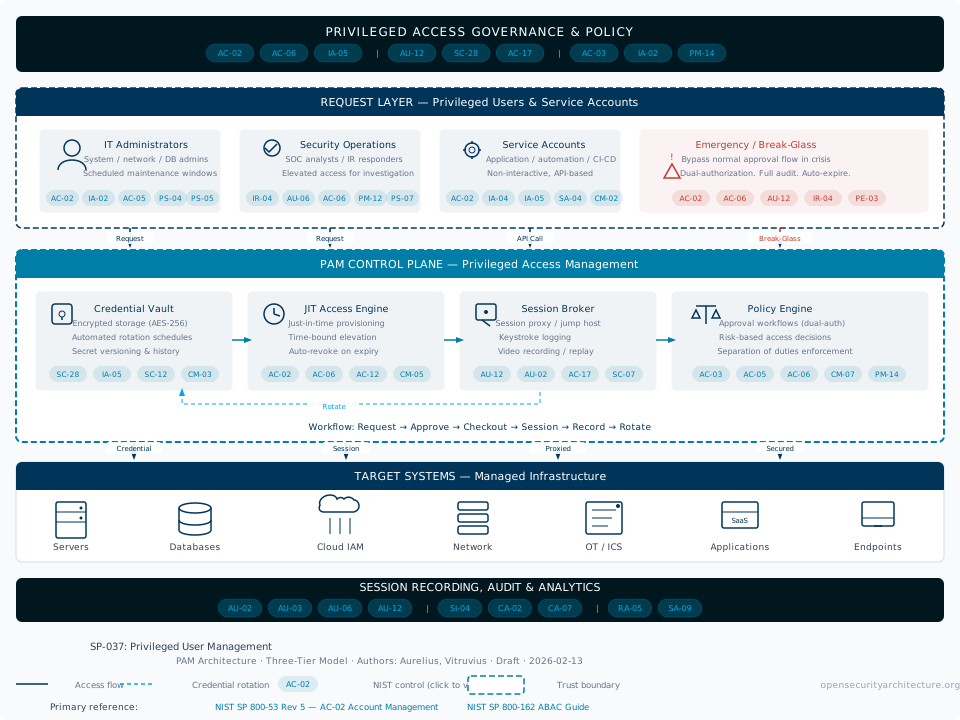
Key Control Areas
Credential Vaulting and Lifecycle Management
Just-In-Time Access and Zero Standing Privileges
Session Brokering, Isolation, and Recording
Service Account and Application Credential Management
Break-Glass and Emergency Access
Privileged Access Governance and Reviews
Cloud and Hybrid Privileged Access
When to Use
This pattern applies to every organisation with systems that have administrative or root-level access -- which is every organisation. It is particularly critical for: organisations with regulatory obligations around privileged access (financial services, healthcare, government), environments where privileged access abuse could cause significant financial or operational harm (trading systems, payment systems, critical infrastructure), organisations that have experienced breaches involving compromised privileged credentials, environments with large numbers of administrative accounts (Active Directory, cloud IAM, database servers), organisations with significant outsourcing where third-party administrators need privileged access, any organisation implementing or operating Zero Trust Architecture (SP-029) where privileged access is a key control plane.
When NOT to Use
There are no contraindications for privileged access management -- the question is one of scale and sophistication. Very small organisations (under 20 staff) may implement PAM through procedural controls (documented shared credential management, dual-custody for admin passwords) rather than deploying enterprise PAM tooling. Environments with very few systems may not justify the cost of a commercial PAM platform, but should still vault credentials using password managers and enforce MFA on all admin access. Organisations should not attempt to implement full ZSP in a single phase -- start with credential vaulting for the highest-risk accounts, then expand to JIT, then session recording, then ZSP as maturity grows.
Typical Challenges
The most common challenge is cultural resistance: administrators who have had root or domain admin credentials for years resist having them vaulted and requiring checkout. Service account management is where PAM projects stall: thousands of service accounts with embedded credentials in legacy applications that nobody understands. Password rotation breaks things -- applications with hardcoded credentials fail when the vault rotates their password, requiring application remediation before onboarding. Legacy systems that do not support API-driven credential injection require manual or wrapper-based approaches. Cloud IAM adds complexity with multiple identity planes (AWS IAM, Azure AD, GCP IAM) each requiring different integration approaches. Operational Technology environments often have shared credentials on devices that cannot be integrated with PAM. JIT access creates latency: administrators must request and wait for access rather than connecting immediately, which meets resistance for incident response scenarios (hence break-glass). PAM platform availability becomes a single point of failure: if the vault is down, nobody can administer anything, making vault high availability and break-glass procedures essential. Vendor sprawl: many organisations end up with multiple PAM solutions across different technology tiers, creating management and coverage gaps.
Threat Resistance
Privileged User Management directly addresses the most impactful attack techniques. Credential theft via pass-the-hash and Kerberoasting is mitigated by credential vaulting with automatic rotation that ensures stolen hashes expire before they can be exploited (IA-05, AC-02). Lateral movement using compromised admin credentials is limited by JIT access that ensures privileged credentials exist only during approved windows (AC-02, AC-06). Living-off-the-land attacks that abuse legitimate admin tools are detected through session recording and command monitoring that flags anomalous administrative behaviour (AU-12, SI-04). Privilege escalation through misconfigured cloud IAM roles is prevented by continuous discovery and access reviews that identify over-permissioned roles (AC-02, CA-02). Insider threat from privileged users is deterred by session recording and detected by behavioural analytics on privileged access patterns (AU-06, PM-12). Service account compromise -- one of the most common initial access vectors for advanced attackers -- is mitigated by vaulting service account credentials, rotating them automatically, and restricting their network and logon scope (IA-05, CM-02). The fundamental principle: if an attacker cannot obtain a privileged credential, cannot use it without detection, and cannot persist with it because it rotates, the value of compromising any single account is dramatically reduced.
Assumptions
The organisation has an identity management capability that can enumerate and classify accounts (see SP-010). A credential vaulting solution is deployed or budgeted for. Network architecture supports session brokering through jump servers or PAM proxies. Systems support the concept of individual accountability -- shared admin credentials are being eliminated. Change management processes exist to link privileged access to approved changes. Security monitoring is in place to consume and alert on privileged access events (see SP-031). Management understands that PAM introduces operational friction by design and supports the trade-off.
Developing Areas
- Just-in-time access is maturing as the standard model for human privileged access, but adoption remains uneven. Cloud-native JIT (Azure PIM, AWS IAM Identity Center) covers approximately 40% of enterprise cloud admin access, while on-premises JIT through PAM platforms covers less than 25% of domain admin access. The gap is widest for network devices, databases, and legacy applications where JIT integration requires custom API development or wrapper scripts that most PAM vendors do not support out of the box.
- Cloud PAM for ephemeral infrastructure is an unsolved architectural challenge. In environments where infrastructure is created and destroyed in minutes (Kubernetes pods, Lambda functions, auto-scaling groups), traditional PAM models of credential checkout and session recording do not apply. Emerging approaches include workload identity federation, short-lived certificate-based authentication, and policy-as-code access controls, but no unified PAM model spans both persistent infrastructure and ephemeral cloud-native workloads.
- Zero standing privilege adoption is the stated aspiration of most PAM programmes but the operational reality of fewer than 5% of enterprises. The primary blockers are service accounts with embedded credentials in legacy applications, shared admin credentials on network devices, and break-glass requirements that inherently require pre-positioned standing access. Measuring progress toward ZSP (ratio of standing to JIT privileges) is itself an emerging practice that most PAM platforms do not natively support.
- Privileged access for AI agents and autonomous service accounts is a rapidly emerging challenge with no established governance model. AI coding assistants, automated remediation bots, and orchestration platforms increasingly require elevated privileges to perform their functions, but they do not fit human-centric PAM models of checkout, approval, and session recording. The question of how to apply least privilege, accountability, and session monitoring to non-human entities operating at machine speed is largely unanswered by current PAM architectures.
- Session recording analytics and anomaly detection are evolving from passive storage to active monitoring. Traditional session recording produces terabytes of video and command logs that nobody reviews unless an incident occurs. Emerging capabilities use NLP and behavioural analytics to flag anomalous commands, detect privilege abuse patterns, and alert on high-risk actions in real time. However, the false positive rates remain high and the privacy implications of analysing every administrator keystroke are creating friction with works councils and privacy regulators in the EU.
Related Patterns
Patterns that operate within or alongside this one. Click any to view.
References
- NIST SP 800-53 Rev 5: Security and Privacy Controls
The control catalogue referenced throughout this pattern. Access Control (AC) and Identification and Authentication (IA) families are primary.
- CyberArk: Privileged Access Management
Market-leading PAM platform. Reference implementation for credential vaulting, session isolation, and JIT access patterns described in this pattern.
- NIST SP 800-63B: Digital Identity Guidelines - Authentication
Authentication assurance levels and authenticator requirements. Relevant for privileged access authentication standards including MFA requirements.
- Microsoft: Privileged Access Strategy
Microsoft's enterprise privileged access strategy including PAWs, tiered admin model, and Azure PIM. Practical reference for Windows/Azure environments.
- MITRE ATT&CK: Privilege Escalation Tactics
Catalogue of privilege escalation techniques used by real-world adversaries. Essential reading for understanding what PAM controls are designed to prevent.
- CIS Controls v8: Control 6 - Access Control Management
CIS guidance on access control management including privileged access. Provides implementation groups aligned to organisational maturity.
- HashiCorp Vault: Secrets Management
Cloud-native secrets management platform. Reference implementation for dynamic secrets, short-lived credentials, and API-driven credential retrieval patterns.
- Gartner: Privileged Access Management Magic Quadrant
Market landscape for PAM solutions. Useful for vendor evaluation and understanding the breadth of capability expected in enterprise PAM.