Tokenised Asset Security Architecture
Click any control badge to view its details. Download SVG
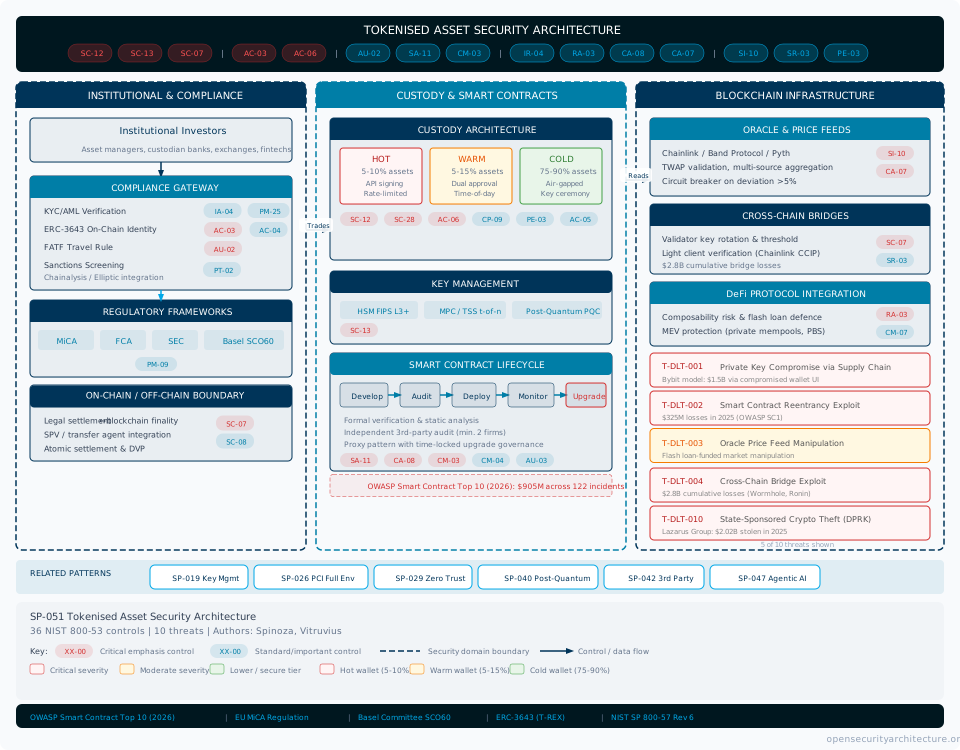
Key Control Areas
Custody Architecture and Cryptographic Key Management
Smart Contract Security Lifecycle
Oracle and Price Feed Security
On-Chain/Off-Chain Security Boundary
DeFi Protocol Integration and Composability Risk
Cross-Chain Bridge and Interoperability Security
Regulatory Compliance and Digital Asset Lifecycle
Incident Response and Recovery for Digital Assets
When to Use
Financial institutions building tokenised bond, equity, or fund platforms for institutional investors. Asset managers launching tokenised money market funds or structured products (following BlackRock BUIDL, Franklin Templeton BENJI precedent). Custodian banks adding digital asset custody services following SEC SAB 122 and OCC guidance. Exchanges or trading venues listing tokenised securities or RWA tokens. Fintech firms building tokenisation-as-a-service platforms for issuers. Organisations subject to MiCA, FCA, or SEC regulation that process tokenised financial instruments. Any institution where compromise of private keys could result in loss of client assets exceeding the organisation's risk appetite.
When NOT to Use
Organisations using blockchain solely for internal record-keeping or provenance tracking where no financial assets are at risk -- the custody and key management controls are disproportionate. Pure utility token projects without securities regulation applicability. Organisations with no plans to interact with public blockchain networks (purely internal permissioned ledger deployments may need a subset of controls but not the full DeFi integration, bridge security, or MEV mitigation sections). Retail cryptocurrency exchanges focused on spot trading of Bitcoin/Ethereum where the primary concern is traditional exchange security (see SP-019 Key Management) rather than smart contract and composability risk.
Typical Challenges
The most fundamental challenge is key management at institutional scale. Unlike traditional PKI where certificate authorities provide key lifecycle management, blockchain private keys have no recovery mechanism -- if a key is lost, the assets it controls are permanently inaccessible, and if a key is compromised, the assets can be irreversibly stolen. MPC and threshold signature schemes mitigate single-key risk but introduce operational complexity: key ceremony procedures, share rotation, and recovery testing require specialist expertise that most financial institutions lack internally. Smart contract immutability creates a deployment paradox: contracts must be thoroughly audited before deployment because post-deployment fixes require complex upgrade mechanisms (proxy patterns) that themselves introduce new vulnerability classes (OWASP SC10). The cost of comprehensive smart contract auditing is significant ($50K-$500K per audit from specialist firms), and the pool of qualified auditors is small relative to demand, creating bottlenecks. Regulatory fragmentation across jurisdictions creates compliance complexity: the same tokenised bond may be subject to MiCA in the EU, FCA rules in the UK, and SEC custody requirements in the US, each with different record-keeping, reporting, and capital treatment obligations. The Basel Committee's Group 1a/Group 2 classification directly affects the economic viability of holding tokenised assets on a bank's balance sheet. DeFi composability risk is poorly understood by traditional risk frameworks: when a tokenised treasury fund is used as collateral in a lending protocol that sources prices from an oracle that aggregates data from DEXs that are subject to MEV extraction, the risk chain extends far beyond the organisation's direct control. Cross-chain interoperability remains architecturally immature: bridge security is the weakest link in multi-chain deployments, and the $2.8B in bridge losses demonstrates that no current bridge architecture provides the level of assurance that institutional assets require. State-sponsored threat actors (DPRK/Lazarus Group: $2.02B stolen in 2025) specifically target cryptocurrency infrastructure with sophisticated supply chain attacks, as demonstrated by the Bybit incident where the Safe{Wallet} UI was compromised to display correct transaction details to signers while submitting different transactions to the blockchain.
Threat Resistance
This pattern provides defence-in-depth across the tokenised asset threat landscape. Private key compromise -- the highest-impact risk, responsible for 70% of stolen cryptocurrency in 2024 -- is mitigated through MPC/threshold custody architecture (SC-12, SC-13) that eliminates single-key risk and requires multi-party collusion for any signing operation. Smart contract exploitation (OWASP SC01-SC10, $905M in 2025) is addressed through mandatory pre-deployment audits, formal verification of critical invariants, and upgrade governance with timelock and multi-signature controls (SA-11, CM-03, CA-08). Oracle manipulation ($8.8M direct losses but enabling much larger compound attacks) is mitigated through multi-source oracle aggregation, staleness checks, price bound validation, and circuit breakers (SI-10, CA-07). Flash loan attacks are countered by designing contract logic that does not depend on instantaneous state that can be manipulated within a single transaction. Cross-chain bridge exploits ($2.8B total) are addressed through bridge architecture selection (preferring native verification over lock-and-mint), bridge monitoring, kill switch capability, and exposure limits (SC-07, IR-04). Supply chain attacks on wallet infrastructure (Bybit pattern) are mitigated through independent transaction verification: signers must verify transaction details through an independent channel (hardware wallet display, separate verification service) rather than trusting the signing UI alone. MEV/front-running ($289.76M in sandwich attacks) is mitigated through private transaction submission and encrypted mempool services. Regulatory non-compliance is addressed through on-chain compliance enforcement via ERC-3643 identity framework, automated travel rule data exchange, and multi-jurisdictional reporting (AU-02, AC-03). Residual risks include: state-sponsored actors with zero-day capabilities (DPRK teams embedded as insider threats within crypto firms), smart contract logic errors not caught by formal verification or audits, regulatory divergence creating conflicting compliance obligations, and the fundamental irreversibility of blockchain transactions which limits recovery options after successful exploitation.
Assumptions
The organisation is building or integrating a tokenised asset platform that will issue, manage, or custody tokens representing real-world financial instruments (bonds, equities, fund shares, structured products) on one or more public or permissioned blockchains. The target blockchains support smart contracts (Ethereum, Polygon, Avalanche, Solana, Cardano, or equivalent). The organisation is subject to securities regulation in at least one jurisdiction (EU/MiCA, UK/FCA, US/SEC, Singapore/MAS) and must comply with AML/KYC requirements including the FATF travel rule. A qualified custodian or institutional-grade custody solution (Fireblocks, Copper, Anchorage, or self-operated MPC/HSM infrastructure) is available or being evaluated. The organisation has smart contract development capability or access to specialist blockchain development firms, and budget exists for mandatory pre-deployment security audits by specialist firms. Traditional financial services security controls are already in place (see SP-019 Key Management, SP-026 PCI Full Environment) and this pattern extends the baseline with blockchain-specific controls.
Developing Areas
- Post-quantum readiness for tokenised assets is an urgent concern for long-dated instruments. A 30-year tokenised bond issued today on Ethereum uses ECDSA secp256k1 signatures that will be vulnerable to quantum attack within the bond's lifetime. NIST PQC standards (ML-KEM in FIPS 203, ML-DSA in FIPS 204, SLH-DSA in FIPS 205) are finalised but not yet supported by major blockchain networks. Organisations should implement crypto-agility: abstract signing operations behind interfaces that can migrate to post-quantum algorithms when blockchain network support arrives. Hybrid signature schemes (classical + PQC) are being explored for transition periods. See SP-040 Post-Quantum Cryptography for algorithm-level guidance.
- Institutional DeFi is emerging as a distinct category: protocols with KYC-gated pools, compliant AMMs (Uniswap v4 hooks enabling compliance checks), and permissioned lending protocols that accept only KYC-verified counterparties. Aave Arc, Compound Treasury, and Maple Finance represent early institutional DeFi. Security architecture must address the tension between DeFi composability (open, permissionless) and institutional compliance (closed, permissioned). ERC-3643 compliance enforcement at the token level provides one solution: the token itself refuses non-compliant transfers regardless of which protocol initiates them.
- L2 sequencer decentralisation is critical for institutional adoption. Most L2 networks (Arbitrum, Optimism, Base) currently operate centralised sequencers, creating a single point of failure and trust dependency that institutional risk frameworks struggle to accept. Arbitrum and OP Mainnet achieved Stage 1 classification with permissionless fraud proofs, but full sequencer decentralisation remains on roadmap. Organisations deploying tokenised assets on L2 should evaluate sequencer trust assumptions, forced exit mechanisms (can assets be withdrawn to L1 if the sequencer is down?), and governance upgrade risks (can a small multi-sig modify the rollup contract?).
- Tokenised asset insurance is an emerging market addressing the gap between traditional financial instrument insurance (covered by existing insurance markets) and blockchain-specific risks (smart contract exploit, bridge failure, oracle manipulation, key compromise). Nexus Mutual, InsurAce, and traditional insurers (Aon, Marsh) are developing products. Underwriting criteria typically require: completed smart contract audits, MPC/threshold custody, real-time monitoring, and incident response capability -- the controls in this pattern directly support insurability.
- Central Bank Digital Currencies (CBDCs) and tokenised asset interoperability: MAS Project Guardian, BIS Project Agorá, and the Bank of England's digital pound exploration all contemplate interoperability between CBDCs and tokenised securities for atomic delivery-versus-payment (DvP). The security architecture for CBDC-settled tokenised assets requires additional controls for central bank interface security, CBDC custody (distinct from commercial token custody), and settlement finality guarantees that differ from standard blockchain confirmation models.
Related Patterns
Patterns that operate within or alongside this one. Click any to view.