DMZ Module
Click any control badge to view its details. Download SVG
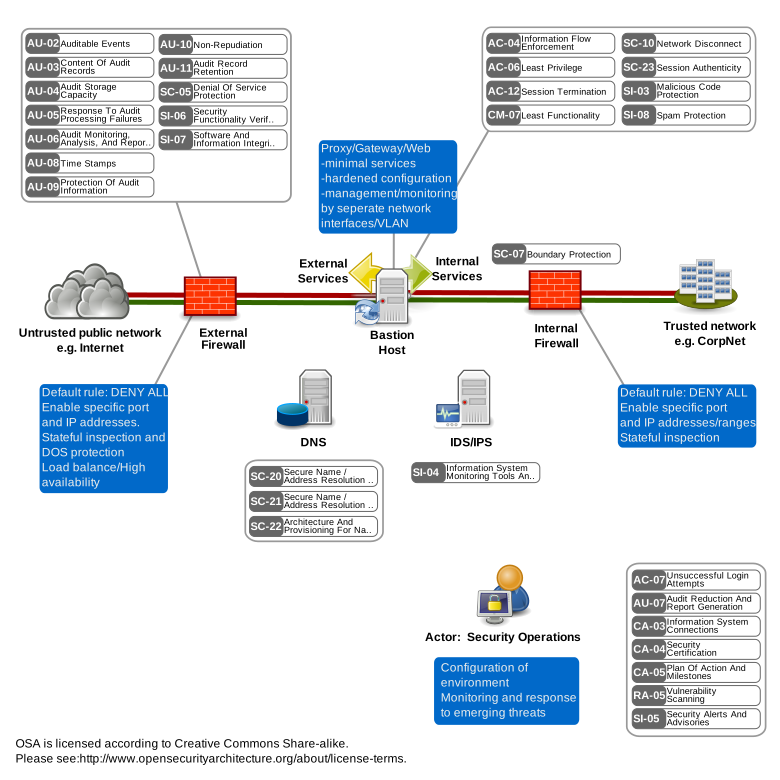
Key Control Areas
Information Flow and Access Control
Comprehensive Audit and Logging
System Hardening and Vulnerability Management
Malicious Content and Intrusion Detection
DNS Security
Network Resilience and Session Security
Security Assessment and Remediation
When to Use
Any organisation with a secure computing environment that connects to untrusted networks. Organisations hosting internet-facing services (web applications, email, VPN, APIs). Environments requiring regulatory compliance that mandates network segmentation (PCI DSS, SWIFT CSP). Organisations with multiple security zones requiring controlled traffic flow between trust levels. Any environment where internal systems must be protected from direct exposure to internet-sourced threats.
When NOT to Use
Single-user environments such as home users without server infrastructure. Very small organisations that consume only cloud-hosted SaaS services and have no on-premises servers or internet-facing infrastructure. Environments that have fully adopted zero-trust network access models where traditional perimeter-based DMZ concepts are replaced by identity-based micro-segmentation -- though even in these cases, the underlying principles of traffic inspection and zone separation remain relevant.
Typical Challenges
Skilled firewall administrators are essential to ensure that firewall rules do not contain errors that create security holes -- rule complexity grows over time and accumulated legacy rules are a common source of vulnerabilities. Skilled security and server engineers are needed to implement and maintain hardened builds for gateway and bastion host systems. Remodelling an existing flat or poorly segmented environment into a proper DMZ architecture is significantly more difficult than building from scratch. The recommended approach for remodelling is: first, isolate in the DMZ those services with an intermediate role (web frontends, antivirus servers, content inspection servers, SSL VPN portals, captive portals); second, plan traffic rules on the firewall layer to route only a very restricted set of services, especially concerning traffic from the DMZ to the internal network and from the internet to the DMZ, ensuring absolutely no direct traffic from the internal network to the internet; third, optionally add intrusion prevention systems at two strategic points -- in front of server networks for defence in depth and data isolation, and between the internal network and DMZ to contain propagation of worms and fast-spreading zero-day attacks. Managing encrypted traffic inspection at scale introduces certificate management complexity and privacy considerations. Cloud and hybrid architectures complicate traditional DMZ models, requiring adaptation of the pattern to virtual network constructs, cloud-native firewalls, and zero-trust network access approaches.
Threat Resistance
Denial-of-service attacks targeting internet-facing services, including volumetric DDoS, application-layer floods, and protocol exploitation. Network-based attacks including port scanning, service enumeration, and exploitation of vulnerabilities in exposed services. Web application attacks such as SQL injection, cross-site scripting, and remote code execution targeting DMZ-hosted applications. Lateral movement from compromised DMZ hosts into the internal network. DNS-based attacks including cache poisoning, DNS tunnelling for command-and-control, and DNS amplification attacks. Malware delivery through web traffic, email attachments, or file transfer services hosted in the DMZ. Session hijacking and man-in-the-middle attacks against DMZ-hosted services. Brute-force and credential-stuffing attacks against authentication services exposed through the DMZ. Unauthorised network access through misconfigured firewall rules or undocumented network flows.
Assumptions
The organisation operates a network environment that connects to one or more untrusted networks, typically the internet. A multi-tier firewall architecture is available or planned, with physically or logically separate firewall instances for the external and internal DMZ boundaries. Encryption should be used for sensitive traffic; it may be necessary to break the session at the gateway (bastion host) to inspect traffic depending on content monitoring requirements. Skilled firewall administrators and security engineers are available to implement and maintain the hardened configuration. The organisation has or will establish a centralised logging and monitoring capability to consume DMZ audit data. Network segmentation principles are understood and supported by the network infrastructure.
Developing Areas
- The relevance of traditional DMZ architecture in cloud-first organisations is being actively debated. As workloads move to cloud providers where the perimeter is the identity layer rather than a network boundary, the classic two-firewall DMZ with bastion hosts is becoming an on-premises artefact. Cloud equivalents (public subnets with ALBs, API gateways, cloud WAFs) serve the same function but use fundamentally different implementation patterns. Organisations operating hybrid estates must maintain both traditional and cloud DMZ architectures with different tooling, skills, and operational processes -- a duplication that increases complexity and cost.
- API gateways are emerging as the modern equivalent of DMZ bastion hosts, providing the inspection, authentication, and rate-limiting functions that reverse proxies and WAFs traditionally performed. However, API gateways operate at Layer 7 with richer protocol understanding (GraphQL, gRPC, WebSocket) and deeper integration with identity providers and developer platforms. The transition from network-centric DMZ thinking to API-centric boundary protection requires architectural mindset shifts that many network security teams have not yet made, and the skills required to configure API gateway security policies differ significantly from traditional firewall administration.
- Micro-segmentation is challenging the zone-based model that DMZs represent. Rather than routing all traffic through defined network zones separated by firewalls, micro-segmentation applies per-workload policies that follow the application regardless of network location. In this model, the DMZ concept dissolves into granular identity-based policies applied at every workload. The practical reality is that most organisations are years away from comprehensive micro-segmentation and continue to rely on zone-based architectures, but the architectural direction suggests that the DMZ as a distinct network segment may eventually be superseded by distributed enforcement points.
- East-west inspection scaling is an emerging challenge as organisations recognise that the majority of malicious traffic in modern breaches moves laterally within the network rather than crossing the traditional DMZ boundary. Deploying IDS/IPS and content inspection at the volume and speed required for internal traffic between application tiers, databases, and management systems demands purpose-built hardware or distributed software sensors that most DMZ architectures were never designed to accommodate. Vendors are responding with distributed inspection platforms, but the cost and performance implications of inspecting all internal traffic remain significant constraints.
Related Patterns
Patterns that operate within or alongside this one. Click any to view.