SOA Publication and Location Pattern
Click any control badge to view its details. Download SVG
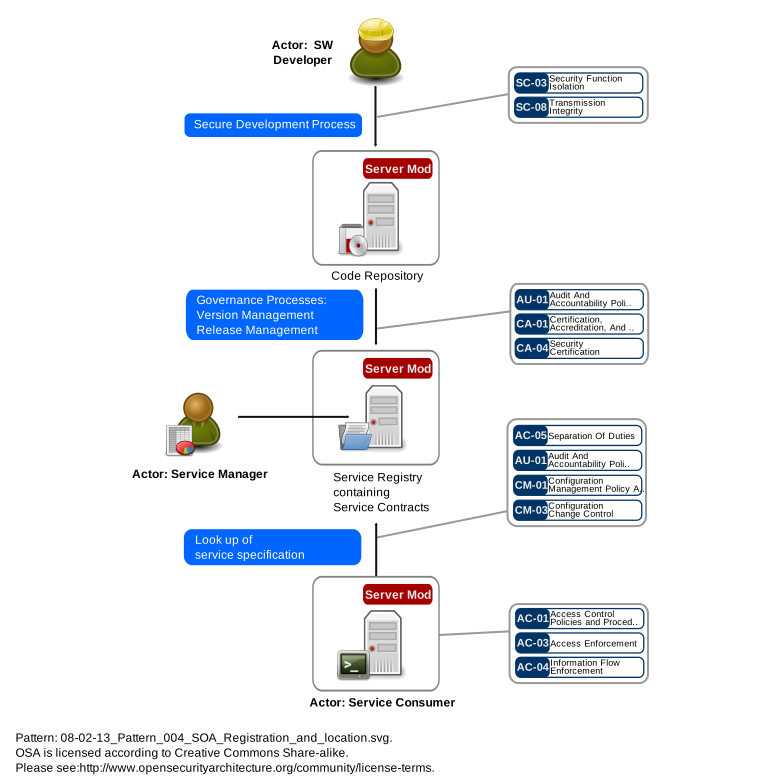
Key Control Areas
Registry Access Control
Audit and Accountability
Security Assessment and Certification
Configuration and Change Management
Lifecycle and Engineering Principles
When to Use
Use this pattern whenever your architecture includes a service registry, API catalogue, or service mesh that mediates discovery between service providers and consumers. It is particularly important when you can distinguish between trusted and untrusted callers -- for example, internal services versus partner-facing APIs. Apply it when services are composed dynamically at runtime based on registry lookups, as a compromised registry entry in this context enables man-in-the-middle attacks at the application layer. Also applicable when regulatory or compliance requirements mandate traceability of service publication and change history.
When NOT to Use
If all potential service consumers are equally trusted and operate within a single, tightly controlled environment with no external exposure, the overhead of full registry protection may not be justified. Very small deployments with a handful of static services and no dynamic discovery may not benefit from the full pattern, though basic access control on service definitions is still recommended. This pattern does not address end-to-end message security between services -- for that, see the SOA Internal Service Usage pattern (SP-005).
Typical Challenges
Enforcing service contracts remains difficult because there are few mature standards for automated contract validation and policy enforcement. While tooling exists for API gateway policy enforcement and contract testing, many organisations still rely on manual review processes that do not scale as the number of services grows. Legacy SOA registries (UDDI) often lack fine-grained access control, making it hard to restrict publication rights without custom development. In microservices architectures, service discovery is often automated through service meshes (Istio, Consul), which introduces new attack surfaces around the mesh control plane. Maintaining consistency between registry entries and actual deployed service configurations is an ongoing operational challenge, particularly when deployments are automated but registry updates are not.
Threat Resistance
This pattern addresses threats from rogue employees who could publish a malicious service to intercept or manipulate transactions, rogue developers who could modify a service endpoint to redirect traffic, and rogue suppliers who could register an unauthorised service impersonating a legitimate provider. It mitigates unauthorised service publication, registry tampering, and service impersonation attacks. The combination of access control, separation of duties, change management, and security certification creates multiple barriers that an attacker must overcome to successfully compromise the service discovery infrastructure. It does not protect against threats at the transport or message layer, which are addressed by complementary patterns.
Assumptions
The service registry is a shared, network-accessible component that multiple systems rely on for service discovery. Service interfaces (WSDL, OpenAPI specs) represent implicit contracts between providers and consumers; modifying them has downstream impact. The organisation uses some form of centralised or federated service catalogue, whether a traditional UDDI registry, API gateway, service mesh, or equivalent. Certificate-based or token-based authentication is available for machine-to-machine registry access.
Developing Areas
- API gateways have evolved from simple traffic proxies into full security enforcement points, but the convergence of gateway, service mesh, and API management functionality is creating architectural confusion. Organisations struggle to determine where to enforce authentication, rate limiting, and authorisation when Kong, Istio, and Apigee all offer overlapping capabilities. No industry consensus exists on the optimal layering, leading to either duplicated enforcement (performance overhead) or gaps where each layer assumes the other handles security.
- Service mesh security -- particularly mTLS enforcement and fine-grained authorisation policies between services -- is maturing rapidly but operational complexity remains high. Istio, Linkerd, and Consul Connect each take different approaches to certificate lifecycle management, policy definition, and sidecar proxy architecture. Organisations adopting service meshes report 6-12 month learning curves before security policies are consistently enforced, and debugging authentication failures in mesh environments requires specialist skills that are in short supply.
- API-first design principles are pushing service discovery complexity into new territory. As organisations expose hundreds of internal APIs through developer portals, the challenge of maintaining accurate, security-classified API catalogues becomes a governance problem rather than a technical one. Emerging API governance platforms attempt to auto-discover APIs from traffic analysis and code repositories, but accuracy rates for security classification remain below 70%, requiring significant manual curation to prevent sensitive internal APIs from being exposed through self-service portals.
Related Patterns
Patterns that operate within or alongside this one. Click any to view.