Server Module
Click any control badge to view its details. Download SVG
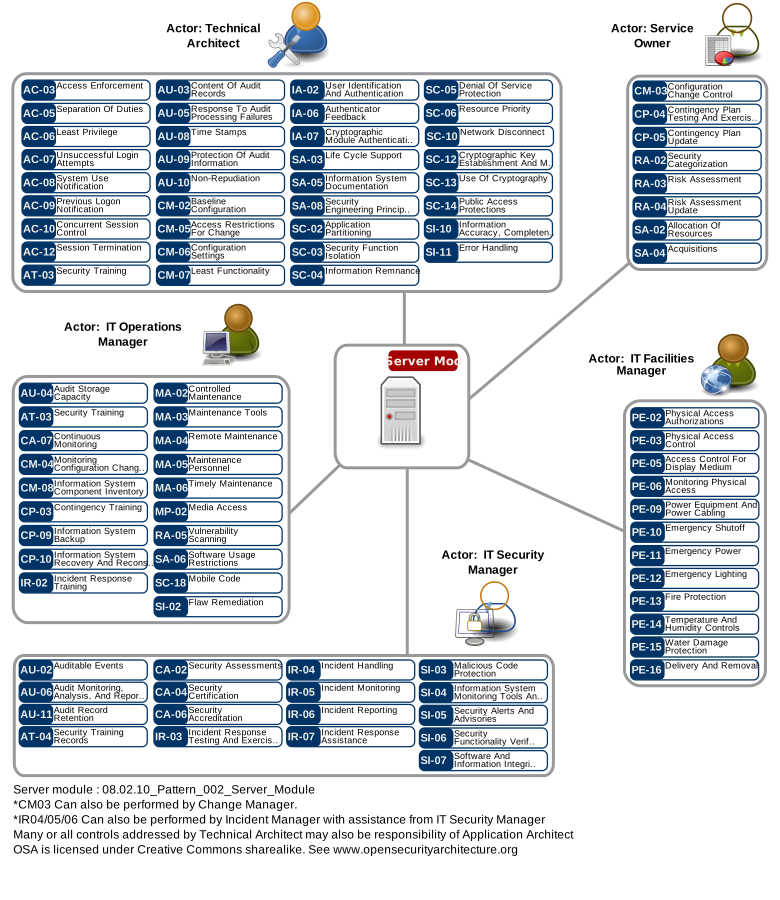
Key Control Areas
Access Control and Privilege Management
Audit Logging, Monitoring, and Analysis
Configuration Management and Server Hardening
Physical and Environmental Protection
Vulnerability Management and Patch Lifecycle
Cryptographic Services and Secure Communications
Incident Response and Recovery
When to Use
This module should be referenced by any OSA pattern that includes a server component in its architecture. It applies to physical servers, virtual machines, cloud instances (IaaS), and any system that provides services to other components rather than directly to end users. It is the standard server baseline for patterns including web server deployments, application platforms, database tiers, directory services, file servers, mail servers, and infrastructure services such as DNS, NTP, and DHCP.
When NOT to Use
This module is not designed for client endpoints (see SP-001 Client Module), mobile devices, or network infrastructure devices (routers, switches, firewalls) which have distinct management models and control requirements. Container orchestration platforms (Kubernetes) and serverless/function-as-a-service deployments require adapted control sets where many traditional server controls are abstracted by the platform. Embedded systems and IoT devices with constrained operating environments cannot implement the full server control baseline. For PaaS and SaaS deployments where the server layer is fully managed by the provider, the physical and environmental controls and many OS-level controls are inherited rather than directly implemented.
Typical Challenges
Server sprawl and configuration drift are persistent challenges: as the server estate grows through organic provisioning, maintaining consistent baselines becomes increasingly difficult without configuration-as-code and automated compliance scanning. Legacy servers running end-of-life operating systems or applications resist hardening and patching, creating risk pockets that compensating controls must address. Patching production servers requires careful change management to balance security urgency with availability requirements -- downtime windows are shrinking while patch volumes increase. Privileged access management is complex when multiple teams (infrastructure, application, database, security) require different levels of administrative access to the same server. Audit log volumes from servers can be enormous, and without proper tuning, critical security events are buried in noise. Physical and environmental controls in colocation or shared facilities may not meet organisational standards, requiring contractual enforcement and audit verification. Virtualisation and containerisation introduce new attack surfaces (hypervisor escape, container breakout) that traditional server controls may not fully address.
Threat Resistance
The Server Module addresses the full range of server-targeted threats. Remote exploitation of unpatched vulnerabilities is mitigated by RA-05 scanning, SI-02 patching, and CM-07 attack surface reduction. Privilege escalation and lateral movement are constrained by AC-06 least privilege, AC-05 separation of duties, and SC-02 application partitioning. Unauthorised administrative access is prevented by AC-03 access enforcement, AC-07 brute-force protection, and IA-02 strong authentication. Data exfiltration is detected by AU-06 log analysis, SI-04 monitoring, and IR-05 incident monitoring. Physical compromise and hardware theft are addressed by PE-02/PE-03 physical access controls and SC-12/SC-13 encryption of data at rest. Environmental threats (power failure, fire, flood, overheating) are mitigated by PE-09 through PE-15. Ransomware and destructive attacks are countered by CP-09 backup with integrity verification and CP-10 recovery procedures. Configuration drift and unauthorised changes are detected by CM-03/CM-04 change control and CA-07 continuous monitoring. Supply chain and integrity attacks are identified by SI-07 software integrity verification.
Assumptions
The organisation operates a managed server infrastructure with centralised configuration management, patch deployment, and monitoring capabilities. Servers are deployed in environments with appropriate physical and environmental controls (data centres, server rooms, or cloud providers with equivalent attestations). Administrative access to servers is controlled through privileged access management, with individual accountability for all administrative actions. Network segmentation exists to separate server tiers (web, application, database) and restrict lateral movement. The organisation has defined service level objectives for availability that inform patching windows and recovery time targets. For cloud-hosted servers, the shared responsibility model is understood and documented.
Developing Areas
- Serverless and container security models are fundamentally challenging the traditional server hardening paradigm. When workloads run as ephemeral containers with sub-second lifetimes or as serverless functions with no visible OS, the entire CM family of controls (baseline configuration, hardening, least functionality) must be reimagined. Container-specific security tools (Aqua, Sysdig, Falco) and serverless security frameworks are emerging but the control mapping to NIST 800-53 is still being formalised by the community.
- Confidential computing technologies -- Intel TDX, AMD SEV-SNP, and ARM CCA -- are moving from research prototypes toward production readiness, promising to protect data in use by encrypting memory at the hardware level. This addresses the long-standing gap where data is vulnerable during processing even when encrypted at rest and in transit. However, performance overhead of 5-15%, limited toolchain support, and the complexity of remote attestation workflows mean that adoption is concentrated in cloud provider managed offerings rather than general enterprise deployment.
- Hardware root of trust and measured boot adoption is accelerating but remains inconsistent across server fleets. Technologies like Intel Boot Guard, AMD Platform Secure Boot, and TPM-based measured boot can provide cryptographic assurance that server firmware and OS have not been tampered with, directly addressing supply chain threats. The challenge is operationalising attestation at scale: collecting, validating, and acting on measurements from thousands of heterogeneous servers requires tooling that most organisations have not yet deployed.
- Immutable infrastructure -- where servers are never patched in place but replaced entirely with freshly built, pre-hardened images -- is becoming the preferred model for cloud-native deployments, eliminating configuration drift by design. However, the transition from mutable to immutable infrastructure requires mature CI/CD pipelines, comprehensive image scanning, and rapid rebuild capabilities that many organisations lack. Hybrid estates where some workloads are immutable and others are traditionally patched create operational complexity and inconsistent security posture.
Related Patterns
Patterns that operate within or alongside this one. Click any to view.