Client Module
Click any control badge to view its details. Download SVG
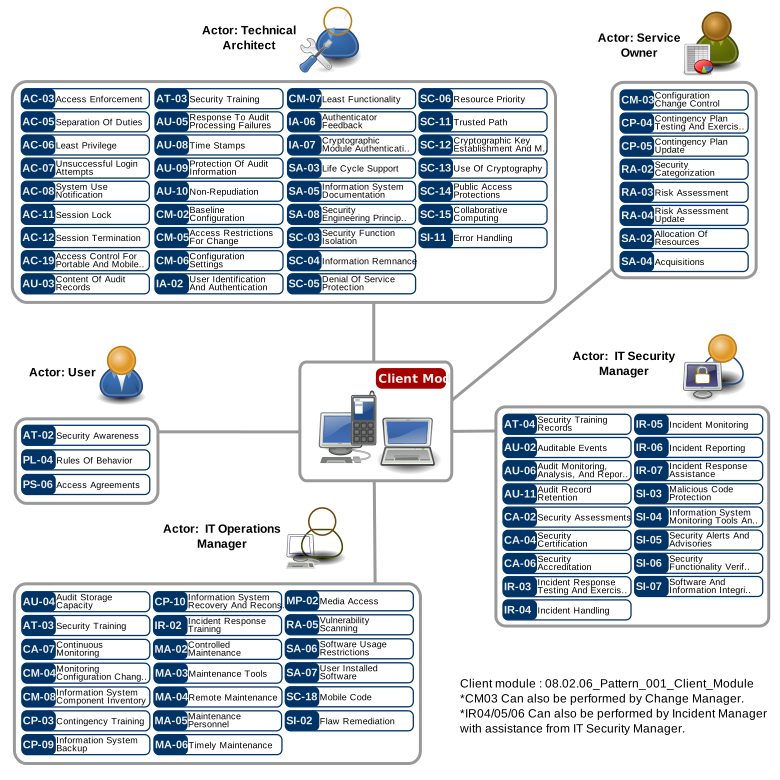
Key Control Areas
Access Control and Session Management
Configuration Management and Hardening
Malware Protection and Software Integrity
Audit Logging and Accountability
Vulnerability and Patch Management
Cryptographic Services
Incident Response Readiness
When to Use
This module should be referenced by any OSA pattern that includes a client endpoint device in its architecture. It applies to corporate desktops and laptops, developer workstations, kiosk systems, shared terminals, and any user-facing computing device that processes, stores, or transmits organisational data. It is particularly relevant when building patterns for remote access, cloud computing, wireless connectivity, and any scenario where endpoints connect to organisational services.
When NOT to Use
This module is not designed for mobile devices (phones, tablets) which have fundamentally different OS architectures, management models, and threat profiles -- see the Mobile Device patterns instead. It does not cover server-class systems (see SP-002 Server Module) or network infrastructure devices. IoT and embedded devices with constrained operating systems require purpose-built control sets rather than this general-purpose client module. Thin clients and virtual desktop infrastructure (VDI) endpoints may require a subset of these controls, with server-side controls handling the remainder.
Typical Challenges
Endpoint diversity is the primary challenge: organisations typically support multiple OS versions, hardware generations, and form factors, making uniform baseline enforcement difficult. BYOD and hybrid work models blur the boundary between corporate and personal devices, complicating control enforcement. Users with legitimate needs for elevated privileges (developers, power users) resist least-functionality restrictions. Legacy applications may require insecure configurations or older runtime environments that conflict with hardening standards. Patch deployment across distributed, intermittently-connected endpoints introduces delays that leave vulnerability windows open. Audit log volumes from endpoints can overwhelm storage and SIEM capacity without careful event selection and filtering. Balancing security controls with user productivity and system performance is a constant tension -- overly aggressive malware scanning or restrictive application whitelisting can impair daily work.
Threat Resistance
The Client Module addresses the full spectrum of endpoint threats. Malware infection through phishing, drive-by downloads, and removable media is countered by SI-03 malware protection, CM-07 least functionality, and SA-06/SA-07 software restrictions. Credential theft and brute-force attacks are mitigated by AC-07 lockout, IA-02 strong authentication, and SC-13 cryptographic protections. Unauthorised data access is prevented by AC-03 access enforcement and AC-06 least privilege. Data loss through theft or loss of physical devices is addressed by SC-12/SC-13 disk encryption. Insider threats are detected through AU-02/AU-03 audit logging and SI-04 monitoring. Exploitation of unpatched vulnerabilities is reduced by RA-05 scanning and SI-02 patch management. Session hijacking and unattended access are prevented by AC-11 session lock and AC-12 session termination. Supply chain and software integrity attacks are detected by SI-07 integrity verification.
Assumptions
The organisation maintains a centralised endpoint management capability (MDM, SCCM, Intune, or equivalent) that can enforce configuration baselines and deploy patches. Network connectivity exists for log forwarding, signature updates, and remote management. Users operate with standard (non-administrative) privileges by default. The organisation has defined data classification policies that inform endpoint encryption and data handling controls. Hardware supports modern security features including TPM, Secure Boot, and virtualisation-based security where applicable.
Developing Areas
- EDR evasion techniques are evolving faster than signature-based detection can adapt. Adversaries routinely use living-off-the-land binaries (LOLBins), reflective DLL injection, and direct syscalls to bypass endpoint agents, with new evasion frameworks appearing on underground markets monthly. Behavioural AI models and kernel-level telemetry are emerging as countermeasures, but the arms race between evasion and detection shows no signs of stabilising.
- BYOD policy enforcement on unmanaged devices remains an unsolved architectural problem. Containerisation and app-level management (Intune App Protection, Android Enterprise) provide partial isolation, but the underlying device posture -- jailbreak status, OS patch level, presence of malware -- is only partially observable on devices the organisation does not own. Privacy-preserving device attestation APIs from Apple and Google are improving but remain inconsistent across platforms and OS versions.
- Browser isolation technology is maturing as a defence against web-based threats but adoption remains below 5% of enterprises. Remote browser isolation (RBI) executes web content in disposable cloud containers, streaming only safe visual output to the endpoint, effectively eliminating drive-by downloads and browser exploit chains. However, performance overhead, rendering fidelity issues, and integration with SaaS applications that rely on local browser capabilities are limiting deployment beyond high-risk user populations.
- Endpoint attestation using hardware root of trust (TPM 2.0, Apple Secure Enclave) is becoming a prerequisite for zero-trust device compliance but the ecosystem is immature. While Windows 11 mandates TPM 2.0 and macOS leverages the Secure Enclave for boot integrity, the tooling to consume attestation signals across heterogeneous fleets and integrate them into conditional access decisions is fragmented across vendors with no interoperable standard.
- Post-quantum TLS deployment to endpoints is an emerging concern as NIST finalised its first post-quantum cryptographic standards (ML-KEM, ML-DSA) in 2024. Browser vendors are beginning hybrid key exchange trials (X25519Kyber768), but enterprise endpoint TLS stacks, VPN clients, and certificate infrastructure are years away from supporting post-quantum algorithms at scale. Organisations face a harvest-now-decrypt-later threat for data transmitted today over endpoints using classical cryptography.
Related Patterns
Patterns that operate within or alongside this one. Click any to view.