Wireless- Private Network Pattern
Click any control badge to view its details. Download SVG
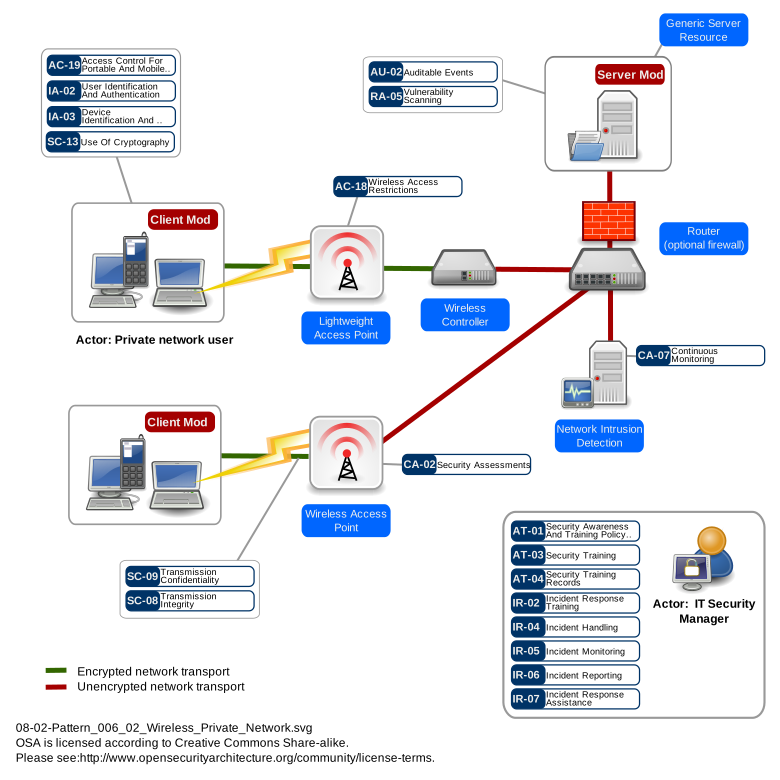
Key Control Areas
Wireless Access and Device Control
Authentication and Device Identity
Cryptographic Protection
Continuous Monitoring and Vulnerability Management
Security Assessment and Compliance
Incident Response for Wireless Events
Awareness and Training for Wireless Security
When to Use
Apply this pattern when providing wireless network access to corporate or organisational network resources from managed locations such as offices, campuses, and facilities where the organisation controls the wireless infrastructure. This is appropriate when the organisation manages the endpoint devices connecting to the network and can enforce configuration requirements including certificate enrollment and 802.1X supplicant configuration. This pattern does not cover Bluetooth, Infrared, or cellular connectivity.
When NOT to Use
This pattern is not appropriate for environments where guest or unmanaged device access is the primary use case -- use a separate guest network or the Wireless Public Hotspot pattern instead. In environments with extreme security requirements where the risk of wireless eavesdropping or signal interception cannot be tolerated, wired-only access should be mandated. The pattern also does not apply where the organisation does not control the wireless infrastructure (airports, hotels, co-working spaces) -- the Public Hotspot pattern applies in those scenarios. Environments with significant RF interference or contested spectrum may find wireless unreliable for business-critical connectivity.
Typical Challenges
Certificate lifecycle management is the most common operational challenge: certificate enrolment, renewal, and revocation must be automated as far as possible, since manual processes break down at scale and expired certificates cause service disruption. Most modern operating systems support 802.1X supplicants and can integrate with enterprise PKI for automatic certificate enrolment and renewal, but heterogeneous device environments (Windows, macOS, Linux, IoT) require careful per-platform configuration and testing. WPA3-Enterprise adoption may be constrained by legacy access points or client devices that do not support it, requiring a transitional period where WPA2-Enterprise remains available. WEP must never be used, as it is trivially broken with publicly available tools, and any environment still relying on WEP should treat the wireless segment as completely untrusted and require VPN overlay -- effectively degrading to the Public Hotspot pattern. Physical placement of access points requires balancing coverage requirements against signal leakage beyond the building perimeter. Guest wireless access should be provided on a separate SSID and VLAN with internet-only access, completely isolated from the corporate network.
Threat Resistance
This pattern provides resistance against wireless eavesdropping through WPA2/WPA3 enterprise encryption, preventing passive interception of corporate traffic over the air interface. Strong 802.1X authentication resists impersonation and unauthorised network access by requiring valid certificates and credentials. Rogue access point detection and wireless intrusion detection address evil twin attacks where adversaries set up fraudulent access points to intercept traffic. Device authentication prevents unauthorised or compromised devices from gaining network access. Network segmentation of wireless traffic limits lateral movement if a wireless client is compromised. The pattern does not fully mitigate denial-of-service attacks against the wireless medium (RF jamming, deauthentication floods with legacy protocols), though WPA3 Protected Management Frames significantly reduce deauthentication attack effectiveness.
Assumptions
The organisation manages its own wireless infrastructure with enterprise-grade access points and controllers. A RADIUS server and PKI infrastructure are available for 802.1X EAP-TLS authentication, or the organisation has the capability to deploy them. Managed endpoint devices support 802.1X supplicants and can be enrolled with machine certificates. Network segmentation exists or can be implemented to isolate wireless traffic from sensitive internal segments until it has been inspected.
Developing Areas
- WPA3 Enterprise adoption remains stubbornly low despite being ratified in 2018. Industry surveys consistently show that fewer than 20% of enterprise wireless deployments have migrated to WPA3, primarily because mixed-mode environments (WPA2/WPA3 transition) introduce compatibility issues with older client devices and because the security benefits over WPA2-Enterprise with 802.1X are incremental rather than transformational. The result is that most enterprise wireless networks remain on WPA2-Enterprise, which is adequate but lacks the improved key exchange and Protected Management Frames that WPA3 mandates.
- IoT device proliferation is overwhelming traditional wireless security models. Enterprise networks now carry traffic from building automation sensors, smart displays, IP cameras, medical devices, and industrial controllers -- devices that often lack 802.1X supplicants, cannot support certificate-based authentication, and run firmware with known vulnerabilities. Dedicated IoT VLANs with MAC-based authentication provide basic segmentation, but the sheer diversity of IoT protocols and the difficulty of maintaining firmware across thousands of devices make this a rapidly growing attack surface with no mature solution.
- Rogue access point detection at enterprise scale faces new challenges as organisations adopt Wi-Fi 6E (6 GHz band) and anticipate Wi-Fi 7. The 6 GHz spectrum doubles the available channel space, meaning existing wireless intrusion detection systems (WIDS) need hardware upgrades to monitor the new band. Additionally, the proliferation of personal hotspots, USB tethering, and cellular failover on employee devices creates a constant stream of rogue AP false positives that erode confidence in detection systems.
- Private 5G networks are emerging as an alternative to enterprise Wi-Fi for campus and industrial environments, offering dedicated spectrum, deterministic latency, and SIM-based device authentication. However, private 5G introduces an entirely new security stack (3GPP security architecture) that enterprise network teams have no experience managing. The intersection of IT wireless security and telecoms security is an unsettled discipline, and the tools for monitoring, threat detection, and incident response on private 5G networks are still being developed by a small number of specialist vendors.
Related Patterns
Patterns that operate within or alongside this one. Click any to view.