Secure Application Baseline for Developers
Click any control badge to view its details. Download SVG
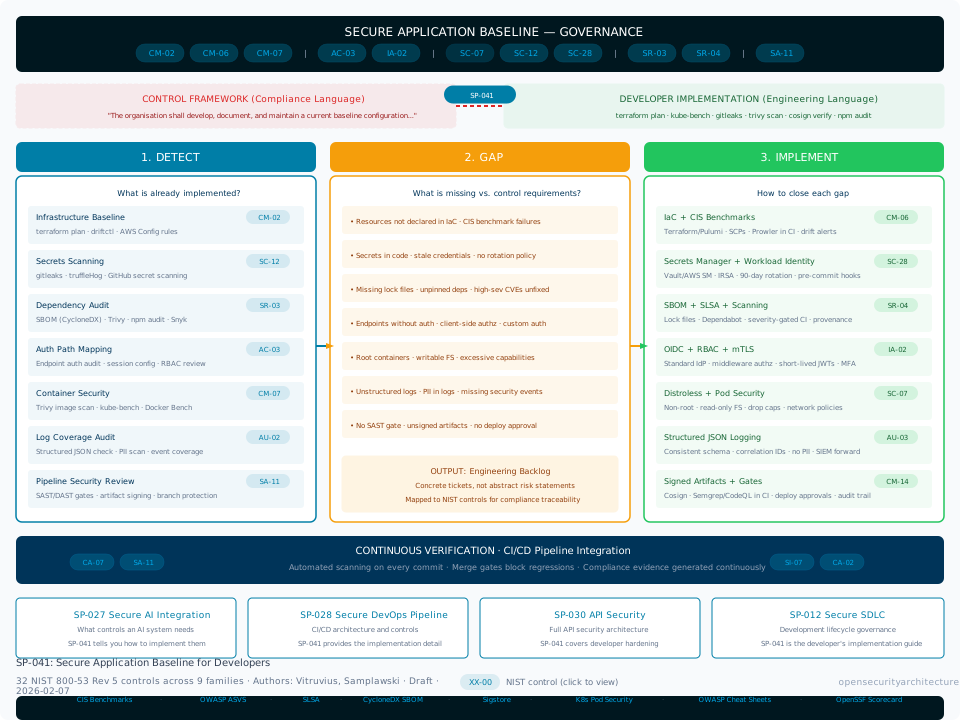
Key Control Areas
Infrastructure Baseline as Code
Secrets and Key Management
Dependency and Supply Chain Security
Authentication and Authorisation
Structured Logging and Audit Trail
Input Validation and Output Encoding
Container and Runtime Security
CI/CD Pipeline Security
API Security Hardening
When to Use
Engineering teams building cloud-native applications who need to satisfy security control requirements. Startups and scale-ups approaching their first security review or compliance certification. Development teams receiving audit findings that they cannot translate into engineering work. Organisations where security architecture exists on paper but implementation is inconsistent. Any team where the question 'how do I actually implement this control?' goes unanswered.
When NOT to Use
Organisations with mature security engineering practices and established internal implementation guides. Legacy systems where infrastructure-as-code and CI/CD pipelines are not feasible without prior modernisation. Operational technology and embedded systems where the development model is fundamentally different from cloud-native application development.
Typical Challenges
Developers perceive security controls as compliance overhead rather than engineering discipline. Security teams write policies in control framework language that developers cannot action. Gap assessments produce risk registers instead of engineering backlogs. Implementation guidance is generic and does not account for the specific technology stack. Security scanning tools generate noise that teams learn to ignore. The translation from control to implementation lives in tribal knowledge and informal documentation that becomes stale.
Threat Resistance
Addresses the implementation gap that allows controls to exist on paper without corresponding technical implementation. Reduces attack surface through automated baseline enforcement and drift detection. Prevents common vulnerability classes (injection, broken authentication, secrets exposure) through systematic input validation, standard auth patterns, and secrets management. Supply chain security through SBOM generation, dependency scanning, and provenance verification. CI/CD hardening prevents pipeline compromise and ensures artifact integrity.
Assumptions
The application team uses a modern development stack with version control (Git), CI/CD pipelines, cloud infrastructure (AWS/GCP/Azure or self-hosted Kubernetes), and containerised deployments. The team has access to standard open-source security tooling. The organisation has identified which NIST 800-53 controls apply to their system.
Developing Areas
- Secure-by-default framework adoption is accelerating, with memory-safe languages (Rust, Go, Swift) gaining traction for security-critical components. The US government (ONCD, CISA) has explicitly recommended migration away from memory-unsafe languages like C and C++. However, the existing codebase in C/C++ is measured in billions of lines, rewrite economics are prohibitive for most organisations, and the developer talent pool for Rust remains limited. The practical path for most teams is incremental adoption of memory-safe languages for new components rather than wholesale migration.
- Runtime Application Self-Protection (RASP) effectiveness remains debated in the security community. RASP promises to detect and block attacks from within the application at runtime, but production deployments report performance overhead of 5-15%, high false positive rates for complex business logic, and difficulty distinguishing legitimate edge cases from attack patterns. The market is consolidating around fewer vendors, and most organisations that deploy RASP use it in monitoring mode rather than blocking mode, limiting its protective value.
- Interactive Application Security Testing (IAST) adoption is growing as a middle ground between SAST (high false positives, no runtime context) and DAST (limited code coverage, slow feedback). IAST instruments the running application to observe data flow and detect vulnerabilities with runtime context, producing fewer false positives than SAST. However, IAST requires instrumentation agents that may not support all language runtimes, and coverage depends on test suite quality. The tool category is approximately 5 years behind SAST/DAST in ecosystem maturity.
- Software composition analysis (SCA) accuracy is improving but still generates significant noise. The core challenge is determining whether a vulnerable dependency is actually reachable in the application's execution path -- a library may contain a vulnerable function that the application never calls. Reachability analysis is an emerging SCA capability that reduces false positives by 40-60% in early implementations, but it requires deep language-specific analysis that not all SCA tools support across all ecosystems.
- AI-generated code security baseline is an urgent developing area as adoption of coding assistants (GitHub Copilot, Cursor, Claude) reaches 50%+ among professional developers. Studies show AI-generated code contains security vulnerabilities at rates comparable to human-written code, but the speed of generation means more vulnerable code reaches review faster. Establishing security scanning gates specifically for AI-assisted development -- mandatory SAST on all AI-generated suggestions, automated secret detection, and dependency validation -- is becoming a critical pipeline requirement that most organisations have not yet formalised.
Related Patterns
Patterns that operate within or alongside this one. Click any to view.