External Attack Surface Management
Click any control badge to view its details. Download SVG
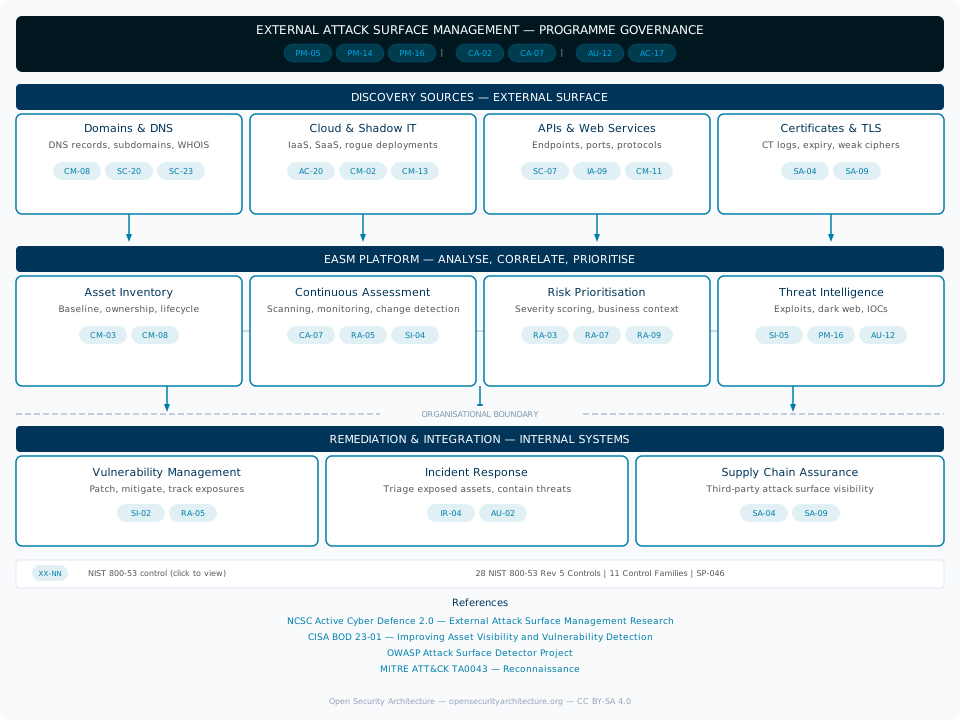
Key Control Areas
Asset Discovery and Continuous Inventory
DNS and Domain Hygiene
Continuous Vulnerability and Exposure Assessment
Cloud and API Surface Management
Certificate and TLS Lifecycle Management
Third-Party and Supply Chain Surface
Remediation Prioritisation and Response
EASM Programme Governance and Metrics
When to Use
Every organisation with internet-facing assets should practice some form of EASM. It is particularly critical for: organisations that have grown through acquisition (inherited infrastructure is a major source of unknown exposure), organisations with significant cloud deployments across multiple providers, regulated industries where external exposure creates compliance risk (financial services, healthcare, government), organisations that have experienced breaches originating from unknown or forgotten internet-facing assets, enterprises with decentralised IT where business units deploy their own cloud resources, organisations with large domain portfolios (hundreds of domains and subdomains), and any organisation subject to the UK NCSC's Active Cyber Defence programme or equivalent national cyber security frameworks.
When NOT to Use
Very small organisations with a handful of well-understood internet-facing services (a single website, an email service) may not justify commercial EASM tooling -- manual monitoring with free tools (Shodan, crt.sh, SecurityTrails) may suffice. Organisations with no internet-facing assets (air-gapped environments) have no external attack surface to manage. However, even organisations that believe they have no internet presence should verify that assumption through at least one baseline discovery scan.
Typical Challenges
The most common challenge is the volume of findings: initial EASM discovery typically reveals far more internet-facing assets than the organisation knew about, and the backlog of findings can overwhelm remediation capacity. False positives consume analyst time -- EASM tools that report every open port without context generate noise. Asset ownership is often unclear: discovered assets may belong to departments, acquired companies, or long-departed employees, and nobody wants to take responsibility for remediating them. Cloud environments are particularly challenging: developers can create internet-facing resources in minutes, faster than EASM can discover them. Multi-cloud and hybrid environments multiply the discovery challenge. Third-party hosted services under your domains are visible to EASM but may not be within your remediation control. Legacy infrastructure that cannot be patched or reconfigured but must remain internet-facing requires compensating controls. EASM tool sprawl: organisations may end up with overlapping tools from different vendors covering different parts of the surface. Integration with existing security tools (SIEM, SOAR, vulnerability scanners, CMDB) requires effort to avoid duplicate findings and conflicting priorities.
Threat Resistance
External Attack Surface Management directly counters the reconnaissance phase of the attack lifecycle -- the phase where adversaries discover your exposed assets, often using the same techniques as EASM tools. Subdomain takeover is prevented through continuous DNS monitoring that detects dangling records before an attacker can claim them (SC-20, CM-02). Shadow IT exposure is discovered and remediated before adversaries find it, closing the gap between what the organisation thinks is exposed and what actually is (CM-08, CM-11). Cloud resource misconfiguration -- the source of some of the most damaging data breaches of the past decade -- is detected through continuous cloud surface enumeration that catches public storage, exposed databases, and open management interfaces (AC-20, SC-07). Expired certificates and weak TLS configurations that enable interception are detected and remediated before they can be exploited (SC-23). Supply chain surface exposure is monitored to detect when third-party security failures create risk for your organisation (SA-09, PM-16). The fundamental principle: if you discover your exposure before the attacker does, you can fix it before it is exploited.
Assumptions
The organisation has internet-facing assets including web applications, email services, APIs, and cloud resources. A vulnerability management programme exists or is being established (see SP-038). DNS administration is performed by the organisation or a managed provider. The organisation has cloud deployments across one or more providers. Budget exists for commercial EASM tooling -- the NCSC buyer's guide provides selection criteria. A security operations capability exists to consume and act on EASM findings (see SP-031). The organisation understands its domain portfolio and registered IP ranges as a starting point for discovery seed configuration.
Developing Areas
- Cloud ephemeral surfaces: Containers, serverless functions, and auto-scaling groups create attack surface that exists for minutes or hours. Traditional EASM tools scan on fixed intervals (daily or weekly), leaving a gap between scan cadence and infrastructure lifespan. Organisations with heavy Kubernetes or Lambda usage find that 20-40% of their external surface is transient and invisible to periodic scanning. Continuous API-driven discovery from cloud provider event streams (CloudTrail, Activity Log) is emerging but not yet standard in commercial EASM products.
- API discovery automation: Enumerating REST and GraphQL endpoints from the outside is fundamentally harder than discovering web servers or open ports. APIs do not announce themselves through DNS records or certificate transparency logs. Crawling, traffic analysis, and documentation scraping (Swagger/OpenAPI files left exposed) are the primary discovery methods, but coverage is incomplete. API sprawl -- particularly internal APIs accidentally exposed through misconfigured API gateways -- remains a significant blind spot in most EASM programmes.
- Attribution and ownership: Discovering assets is the easy part; attributing them to business owners is where most programmes stall. M&A remnants running on legacy infrastructure, shadow IT deployed by marketing teams on personal cloud accounts, and partner-hosted services under shared domains all resist automated ownership mapping. Manual triage of discovered-but-unowned assets consumes 40-60% of EASM operational effort in large enterprises. Graph-based approaches linking assets to identity, billing, and CMDB data are promising but early.
- National-scale EASM: The NCSC Active Cyber Defence 2.0 programme is pioneering EASM at country level -- scanning and monitoring the external surface of an entire nation's critical infrastructure. The challenges are qualitatively different from single-organisation EASM: jurisdictional boundaries, consent models, false positive management at scale, and the political sensitivity of government scanning private infrastructure. This is genuinely novel territory with no established playbook.
- Supply chain surface mapping: Your attack surface includes your CDN, your DNS provider, your SaaS vendors, and their dependencies. The MOVEit, SolarWinds, and Okta incidents demonstrated that compromise often manifests through third-party external surface rather than direct attack. Mapping transitive exposure through supply chain relationships is early-stage: most EASM tools can assess direct vendor surfaces but not nth-party dependencies. Standardised supply chain surface disclosure (analogous to SBOMs for software) does not yet exist.
- Metrics and measurement: Unlike vulnerability management (which has CVSS) or compliance (which has audit pass/fail), EASM lacks an industry-standard measurement framework. Organisations struggle to answer 'what does good look like?' for attack surface reduction. Proposed metrics -- total exposed assets over time, mean time to discover, mean time to remediate, shadow IT ratio -- are useful but not standardised. Benchmarking across organisations is nearly impossible because discovery scope and methodology vary widely between tools and programmes.
Related Patterns
Patterns that operate within or alongside this one. Click any to view.
References
- NCSC: External Attack Surface Management Buyer's Guide
Comprehensive guidance from the UK NCSC on selecting and implementing commercial EASM products. Covers required capabilities, evaluation criteria, and integration considerations.
- NCSC: Active Cyber Defence 2.0 — EASM Trials
Insights from the NCSC's trial of ten commercial EASM products against UK public sector infrastructure. Key findings on discovery effectiveness, false positive rates, and operational considerations.
- NIST SP 800-53 Rev 5: Security and Privacy Controls
The control catalogue referenced throughout this pattern. Configuration Management (CM), Risk Assessment (RA), and System and Communications Protection (SC) families are primary.
- CISA: Binding Operational Directive 23-01 — Asset Visibility and Vulnerability Detection
US CISA directive requiring federal agencies to maintain comprehensive asset inventories and perform vulnerability enumeration on internet-facing assets. Reflects the regulatory expectation for EASM capabilities.
- OWASP: Attack Surface Analysis Cheat Sheet
OWASP guidance on understanding and reducing the attack surface. Provides a framework for categorising attack surface components including network, software, and human elements.
- MITRE ATT&CK: Reconnaissance Tactics (TA0043)
Catalogue of reconnaissance techniques used by adversaries to discover targets. EASM tools use many of the same techniques defensively — understanding the attacker's methodology informs what to monitor.
- Certificate Transparency: Monitoring and Auditing
Public logs of TLS certificate issuance. Monitoring CT logs is a core EASM capability for detecting rogue certificates, unauthorised services, and shadow IT.
- Gartner: External Attack Surface Management Market Guide
Market landscape for EASM solutions including Censys, CyCognito, Mandiant (Google), Palo Alto (Cortex Xpanse), Microsoft Defender EASM, and Randori (IBM). Useful for vendor evaluation.