Mobile Security Architecture
Click any control badge to view its details. Download SVG
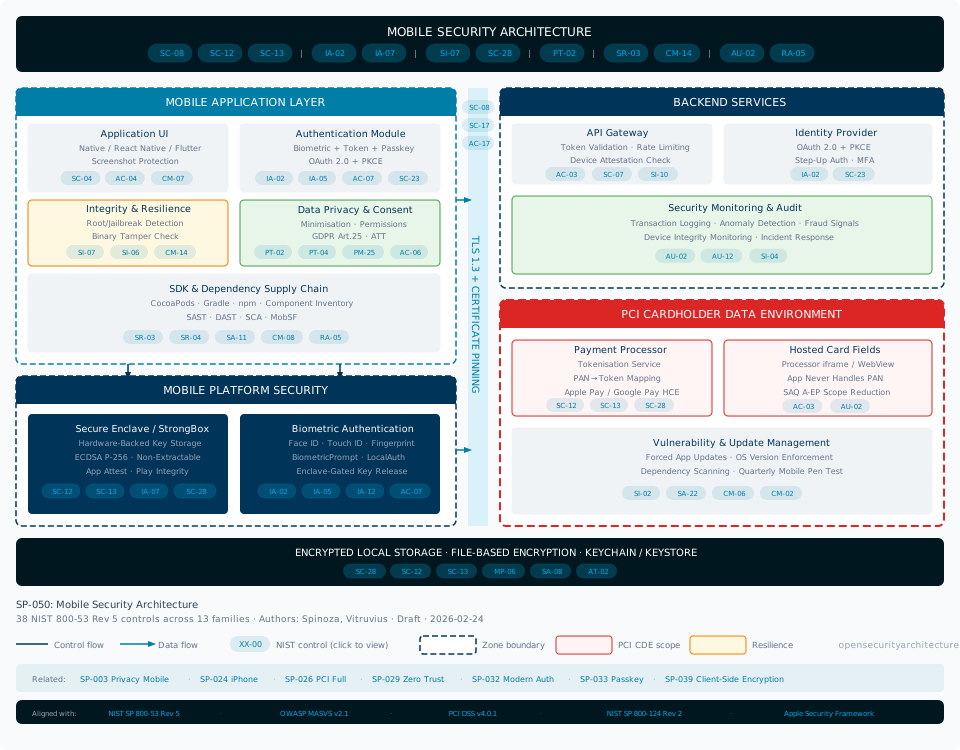
Key Control Areas
Certificate Pinning and Transport Security
Secure Enclave and Hardware-Backed Cryptography
Biometric Authentication and Local Identity
Mobile Payment Security and PCI DSS Scope
Application Integrity and Resilience
Data Protection, Privacy, and Regulatory Compliance
When to Use
Enterprise mobile banking and financial services applications requiring PCI DSS compliance and strong authentication. Healthcare mobile applications handling PHI under HIPAA or patient data under GDPR. Any mobile application processing payment card data via NFC, camera-based card scanning, or manual entry. Government and defence mobile applications with high assurance requirements. Consumer applications handling sensitive personal data (health, financial, identity documents) where a breach would cause significant harm. Mobile applications deployed in high-threat environments where targeted attacks on mobile devices are likely (executive communications, journalism, human rights).
When NOT to Use
Simple content-consumption apps with no sensitive data processing or user authentication -- the overhead of enclave-backed cryptography and integrity checks is disproportionate. Applications targeting very old OS versions (pre-iOS 13, pre-Android 8) where hardware security features are unavailable or limited. Rapid prototyping and MVP phases where security architecture investment should be deferred until product-market fit is validated (but plan for retrofit). Progressive Web Apps (PWAs) that cannot access native platform security APIs -- these should use the Web Crypto API pattern (SP-039) instead. Applications where all sensitive operations are server-side and the mobile client is a thin presentation layer with no local data storage or processing.
Typical Challenges
Certificate pinning is the most operationally fragile control: CA rotations, CDN provider changes, and certificate renewals can break pinned connections, causing app-wide outages that require app store updates to fix. Pin backup keys and implement server-driven pin list updates. Secure Enclave key access requires biometric or device passcode authentication, which creates UX friction -- balance security with usability by caching authentication state for short durations. PCI DSS scope for mobile is poorly understood: many organisations incorrectly believe tokenisation removes them from scope entirely, when in reality the tokenisation process itself, the token vault mapping, and any moment where raw cardholder data exists in memory are in-scope. Hybrid apps (WebView-based) create complex security boundaries: the JavaScript bridge between web and native contexts is a high-value attack surface that must be carefully audited. Cross-platform frameworks (React Native, Flutter) abstract platform security APIs, sometimes with reduced capability or delayed support for new platform features. Application integrity checks generate false positives on legitimate enterprise-managed devices with MDM profiles, developer mode enabled, or accessibility services running -- tune detection to distinguish attacker behaviour from legitimate enterprise configurations.
Threat Resistance
This pattern provides layered defence against the mobile threat landscape. Man-in-the-middle attacks are countered by TLS 1.3 with certificate pinning (SC-08, SC-17), preventing interception even when the attacker controls the network infrastructure (rogue Wi-Fi, compromised carrier). Cryptographic key extraction is resisted by hardware-backed key storage (SC-12, SC-13) -- keys in the Secure Enclave/StrongBox cannot be extracted even with full OS compromise. Biometric bypass and credential theft are mitigated by hardware-rooted biometric authentication (IA-02, IA-07) that binds identity verification to the physical device. Payment data leakage is prevented by tokenisation and CDE boundary enforcement (SC-28, AC-03), minimising the window where raw cardholder data exists. Reverse engineering and binary tampering are detected by integrity checks (SI-07, CM-14), raising the cost of attack for banking trojans and repackaged malware. Jailbreak/root exploitation is detected and mitigated through platform integrity verification (SI-06), with proportional response that degrades sensitive features without denying service. Privacy violations and over-collection are prevented by data minimisation (PM-25, PT-02) and least-privilege permission requests (AC-06). The residual risks are: a sufficiently resourced attacker with physical device access can eventually bypass all client-side controls (the 'evil maid' problem for mobile); supply chain attacks on mobile SDKs can compromise the app at build time; and platform zero-day vulnerabilities can undermine the hardware security assumptions.
Assumptions
The target mobile application runs on iOS 15+ and Android 10+ (API 29+), providing access to modern platform security APIs including Secure Enclave, StrongBox, BiometricPrompt, App Attest, and file-based encryption. The backend infrastructure supports TLS 1.3, token-based authentication (OAuth 2.0 with PKCE), and can validate device attestation tokens. For payment scenarios, a PCI DSS-compliant payment processor or gateway is available to handle tokenisation. The organisation has mobile device management (MDM) or at minimum app-level configuration management for enterprise deployments. Developers have access to mobile-specific security testing tools in the CI/CD pipeline.
Developing Areas
- Passkeys (FIDO2/WebAuthn on mobile) are displacing traditional passwords and OTP-based MFA. Platform authenticators (Face ID, fingerprint) create passkeys stored in the Secure Enclave with cloud sync via iCloud Keychain or Google Password Manager. This collapses the authentication stack: biometric verification, hardware-backed key, and phishing resistance in a single gesture. Adoption is accelerating but cross-platform passkey portability remains fragmented.
- Post-quantum readiness for mobile is an emerging concern. Current enclave-supported algorithms (ECDSA P-256, ECDH) are vulnerable to future quantum computers. NIST PQC standards (ML-KEM, ML-DSA) are not yet supported by mobile hardware security modules. Organisations should implement crypto-agility: abstract cryptographic operations behind interfaces that can swap algorithms when platform support arrives. See SP-040 Post-Quantum Cryptography.
- On-device machine learning creates new data protection opportunities: processing sensitive data (health metrics, face recognition, voice analysis) entirely on-device avoids transmitting raw data to servers. Apple's Core ML and Google's ML Kit provide on-device inference. However, model updates, federated learning telemetry, and crash reports can leak information about user data -- privacy engineering must extend to the ML pipeline.
- Supply chain security for mobile SDKs is a growing attack vector. Banking trojans distributed through compromised advertising SDKs, analytics libraries with hidden data exfiltration, and dependency confusion attacks on package managers (CocoaPods, Maven) have all been observed in the wild. SR-03 supply chain controls must extend to mobile SDK vetting, version pinning, and runtime SDK behaviour monitoring.
Related Patterns
Patterns that operate within or alongside this one. Click any to view.