Board of Directors Room
Click any control badge to view its details. Download SVG
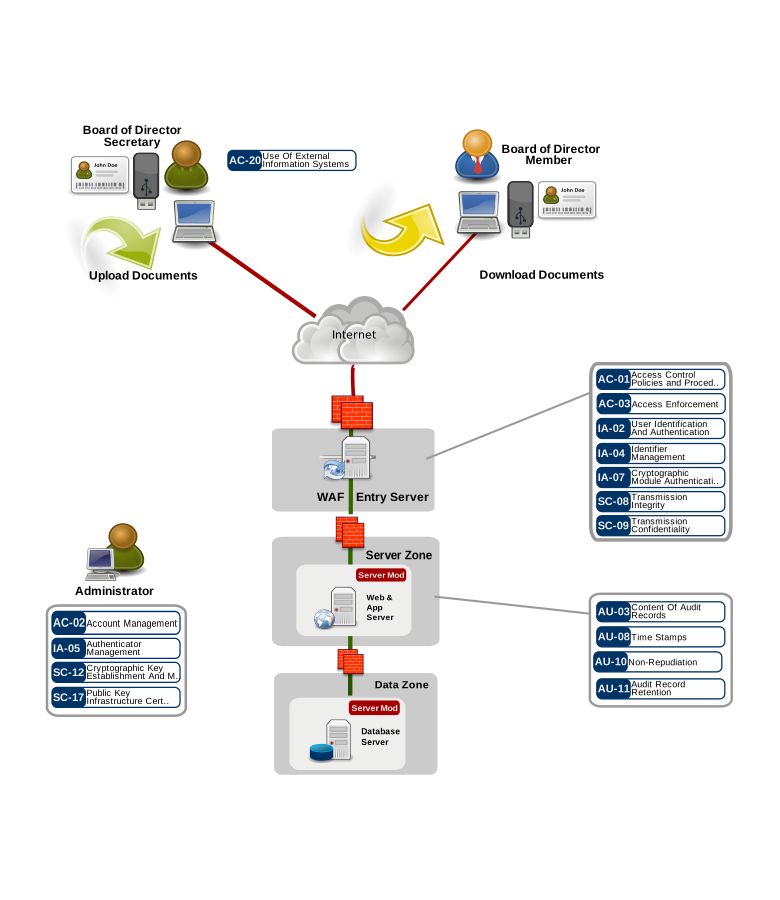
Key Control Areas
Access Control and Account Management
Strong Authentication and Cryptographic Identity
Transmission Security and Cryptographic Protection
Comprehensive Audit and Non-Repudiation
External System and Endpoint Controls
When to Use
Use this pattern when distributing highly sensitive documents to a small group of senior stakeholders who access materials from personal, unmanaged devices. Applicable for board packs, audit committee papers, remuneration committee documents, M&A due diligence materials, and other governance documents where a leak would have material regulatory, financial, or reputational consequences. Appropriate where compliance requirements demand non-repudiation and detailed audit trails of who accessed what and when. Also applicable for similar small-group, high-sensitivity scenarios outside the boardroom: executive committee communications, regulatory correspondence, or legal privilege materials.
When NOT to Use
This pattern is not suitable for large user populations -- the security model relies on individual provisioning, hardware token distribution, and personal onboarding that do not scale beyond tens of users. Not appropriate for ad-hoc collaboration where participants change frequently; the Realtime Collaboration pattern (SP-021) is more suitable for that scenario. Not applicable where all participants use organisation-managed devices with full endpoint security, as the pattern's core value proposition is protecting content on untrusted endpoints. The overhead of this pattern is not justified for documents at normal business sensitivity levels. Not suitable where real-time co-authoring is required -- this is a document distribution and viewing pattern, not a collaborative editing pattern.
Typical Challenges
The fundamental challenge is securing document access on endpoints the organisation does not control. Board members use personal laptops and tablets, often shared with family members, running consumer-grade security. They expect the same ease of use as reading email -- any friction in accessing board packs will result in complaints to the CEO and pressure to weaken controls. Technology literacy varies widely across the board: some directors are digitally fluent, others struggle with basic authentication procedures. Lost or forgotten tokens cause access failures at critical moments (the evening before a board meeting). Screen capture and photography cannot be technically prevented on unmanaged devices -- a director can always photograph their screen. Maintaining security awareness among a population that meets quarterly and views security as someone else's problem is difficult. The board secretariat must balance security procedures with the practical reality of tight timelines for distributing updated papers, sometimes hours before a meeting. Successor and emergency access procedures must exist for the scenario where the board secretary is unavailable and materials must be distributed urgently.
Threat Resistance
The pattern is specifically designed to resist generic trojan horse and keylogger malware on the endpoint where board members read documents. By using a dedicated secure application or hardened browser environment, the attack surface is reduced compared to accessing documents through the device's standard browser. The pattern defends against unauthorised document redistribution through access controls, watermarking, and download restrictions, though it cannot fully prevent a determined insider from photographing the screen. Eavesdropping on network communications is prevented through mandatory TLS encryption for all document transport. Credential theft is mitigated through multi-factor authentication with hardware tokens or certificates. The non-repudiation controls (AU-10) provide forensic evidence if board materials are leaked, supporting investigations and deterring misuse. Residual risks that this pattern acknowledges but cannot fully eliminate include: a board member taking screenshots or photographs of displayed documents; a board member deliberately sharing their secure access device with unauthorised persons; and a targeted, purpose-built trojan specifically designed to attack the board portal application rather than generic malware.
Assumptions
The user population is small and well-defined, typically 10-30 board members plus a small number of board secretaries and administrators. Board members will access documents from personal devices (laptops, tablets, smartphones) that the organisation does not manage and must assume may be compromised by generic malware. The computers used by board secretaries to create and upload documents are within the organisation's managed environment and are secured to an appropriate standard. The organisation can distribute hardware tokens or managed applications to board members during an onboarding process. Board materials are classified at the highest sensitivity level and justify security investment that would be disproportionate for general business use.
Developing Areas
- Deepfake impersonation of executives on video calls is an emerging and rapidly maturing threat to board-level communications. AI-generated video and voice cloning technology can now produce real-time impersonations convincing enough to deceive colleagues, with documented cases of CFO impersonation leading to fraudulent wire transfers exceeding $25 million. Countermeasures including liveness detection, out-of-band identity verification protocols, and AI-based deepfake detection in video streams are developing but not yet widely deployed in board portal or video conferencing platforms.
- CEO fraud and business email compromise using AI voice cloning has escalated beyond email to include phone calls and voicemail. Attackers can clone an executive's voice from a few minutes of publicly available audio (earnings calls, conference presentations) and use it to authorise urgent financial transactions or sensitive data transfers. The security architecture for board communications must now account for voice channel compromise alongside traditional document and email threats, but most board security programmes have not extended their controls to cover voice authentication.
- Personal device use by board members remains architecturally intractable. Board members are typically the most senior and least technically constrained individuals in an organisation, and they routinely access board materials on personal iPads, phones, and laptops shared with family members. The gap between the security posture achievable on a managed corporate device and the reality of an unmanaged personal tablet used by a non-technical director remains wide, and board portal vendors are investing heavily in app-level containerisation to provide data protection independent of the device security posture.
- Secure video conferencing for classified or highly sensitive board discussions is an emerging market segment driven by geopolitical tensions and increased state-sponsored corporate espionage. Traditional board portals secure document access but do not address the security of the video conferencing platform used for board meetings themselves. Purpose-built secure conferencing solutions with hardware-rooted encryption and air-gapped processing are appearing, but they face the same fundamental tension between security assurance and the frictionless experience board members demand.
Related Patterns
Patterns that operate within or alongside this one. Click any to view.