Offensive AI and Deepfake Defence
Click any control badge to view its details. Download SVG
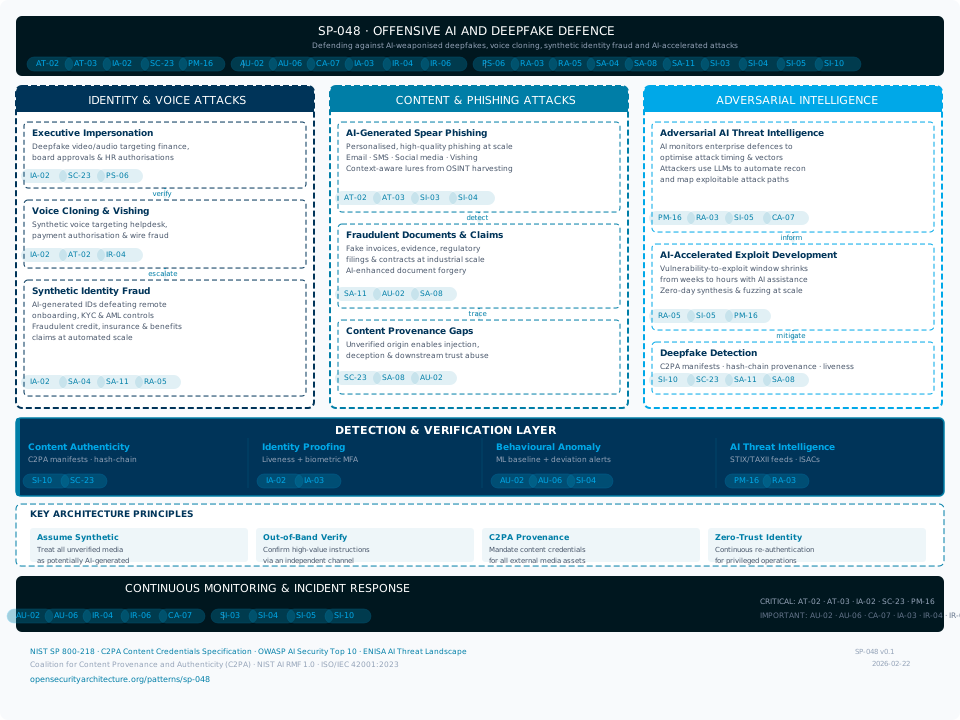
Key Control Areas
Deepfake Detection and Content Authenticity Verification
Executive Impersonation and High-Value Instruction Verification
AI-Generated Phishing Detection and Defence
Synthetic Identity Fraud Controls
Voice Cloning and Vishing Defence
Adversarial AI Threat Intelligence
AI-Accelerated Vulnerability Research and Exploit Development
Content Provenance and AI Disclosure Controls
When to Use
Organisation handles high-value financial transactions that could be targeted by AI-enhanced BEC (wire transfers, supplier payments, cryptocurrency). Executives have publicly available voice recordings (earnings calls, conference talks, podcast appearances, public video) that could be used for voice cloning. Customer onboarding or contractor engagement involves remote identity verification that could be targeted by synthetic identity fraud. Organisation processes externally submitted documents (claims, applications, legal filings) where AI-generated forgeries are a risk. Organisation is in a sector that has seen AI-enhanced fraud: financial services, insurance, legal, healthcare. Security awareness programme has not been recalibrated to reflect AI-era phishing and social engineering.
When NOT to Use
Organisation operates in a fully air-gapped environment with no external communications exposure. All financial authorisations occur in person with verified identity — no remote authorisation channels exist. Organisation does not process externally submitted documents or onboard external parties remotely. Note: the contraindications for this pattern are narrow — almost all organisations with external communications exposure face some version of the threats addressed here.
Typical Challenges
The detection arms race is the central challenge: AI deepfake detection accuracy is outpaced by generation quality improvement, and investing heavily in detection technology creates false confidence in controls that will degrade. Verification-based controls are more durable but require process change rather than technology deployment — changing financial authorisation workflows and employee verification habits is slower and harder than deploying a detection tool. Voice cloning attacks are particularly difficult to counter because they exploit trust relationships that are legitimate in non-attack contexts — the same trust that makes a call from the CEO actionable is what makes a synthetic call dangerous. Threat intelligence on adversarial AI capability is immature: most enterprise threat intelligence programmes track malware, TTPs, and infrastructure but not AI capability development by threat actors. The regulatory landscape for AI-generated content disclosure (EU AI Act Art.50, emerging US state laws) is moving faster than enterprise compliance programmes. Small and mid-sized organisations face the same offensive AI threats as large enterprises but have less capacity to implement verification programmes and content provenance infrastructure.
Threat Resistance
Executive impersonation via synthetic voice or video is addressed through out-of-band verification requirements and safe-word protocols that cannot be satisfied by an AI-generated call regardless of quality, combined with IR runbooks specific to deepfake impersonation incidents. AI-generated phishing at scale is addressed through verification-centric awareness training that shifts the employee posture from content quality assessment to channel verification, combined with technical controls on email infrastructure that remain effective regardless of content quality. Synthetic identity fraud is addressed through graduated identity proofing requirements using authoritative data sources, active liveness detection that resists injection attacks, and vendor assessment requirements that include adversarial AI testing. Voice cloning and vishing are mitigated through call-back procedures to independently verified numbers, safe-word systems, and authenticated communication channel requirements for sensitive conversations. Adversarial AI capability development is tracked through a structured threat awareness programme covering AI-specific threat intelligence sources and incorporated into risk assessments. AI-accelerated exploit development is countered through shortened critical-vulnerability patching timelines calibrated to the compressed exploitation window. Content provenance obligations are addressed through C2PA implementation for outbound content in regulated workflows and content logging requirements.
Assumptions
The organisation is exposed to externally generated threats including social engineering, phishing, and fraud — this pattern is relevant to any enterprise that handles financial authorisations, manages customer identities, employs staff reachable by external communications, or processes externally submitted documents. AI-generated offensive capabilities are available to a broad range of threat actors, not solely sophisticated nation-state actors — voice cloning, image synthesis, and phishing-generation tools are accessible through criminal marketplaces and open-source repositories. Detection-based controls (AI content classifiers) are treated as risk indicators to trigger verification rather than as binary security gates, reflecting the current state of the arms race between generation and detection quality. The organisation has or is developing employee awareness programmes that can be recalibrated to AI-era threats.
Developing Areas
- C2PA ecosystem maturity: the C2PA (Coalition for Content Provenance and Authenticity) standard is being implemented by major camera manufacturers, social platforms, and content management systems, but enterprise adoption is in early stages. The chain of provenance only works if every step signs — a camera-signed original loses its provenance if processed through software that strips or ignores metadata. Enterprise adoption requires both tooling investment and workflow redesign.
- Deepfake detection arms race: academic research consistently shows that deepfake detectors trained on one generation of synthetic media underperform on the next. Commercial detector vendors claim accuracy rates in controlled conditions that do not reflect adversarial deployment. Security teams should treat deepfake detection scores as probabilistic risk signals rather than binary verdicts, and design their verification protocols to function even when detection fails completely.
- Voice authentication recalibration: organisations that use voice biometrics for customer authentication (common in contact centres) are exposed to voice cloning attacks that the original voiceprint cannot defend against. The 2023 and 2024 generation of voice cloning tools can replicate a voiceprint from a short sample with quality sufficient to defeat many deployed voice authentication systems. Banks and insurers using voice authentication should conduct adversarial testing and consider migration to knowledge-based or device-based verification for high-risk transactions.
- EU AI Act Article 50 implementation: the mandatory synthetic content disclosure obligations under EU AI Act Article 50 require organisations deploying AI to generate text, audio, video, or image content at scale to implement technical watermarking or labelling. The harmonised technical standards defining how this must be implemented are not yet finalised by CEN/CENELEC, creating compliance uncertainty. Organisations subject to the regulation should implement best-effort watermarking now (C2PA provenance, invisible watermarking) and prepare for mandatory standard adoption once the technical specifications are published.
Related Patterns
Patterns that operate within or alongside this one. Click any to view.